Sad but true, when it comes to protecting your money and avoid being scammed you have to become vigilant in sharing information to anyone that may target you as part of a scam. It can even be a deepfake voice which is AI generated.
This is one reason banks and investment companies have brought in what is called a Trusted Contact Person or TCP. If you may be under the spell of a scammer, a firm or financial institution where you have a designated TCP may be able to contact them and just let them know you are making an unusually large withdrawal or sending money internationally which was never ever done before and did not fit at all with your normal behavior. It can be quite effective in an unobtrusive way so the transaction is paused until it is verified that it is totally legitimate.
The story below is a feature column by a financial writer who is doing this as part of March being Fraud Awareness Month. When they say time is money you need to take the time and not rush when it comes to protecting your money. Speed of delivery is not your friend if your transfer gets into the wrong hands. Safe should always trump speed when it comes to protecting your money.

By: Joel Schlesinger
Published in the Winnipeg Free Press on March 21, 2026
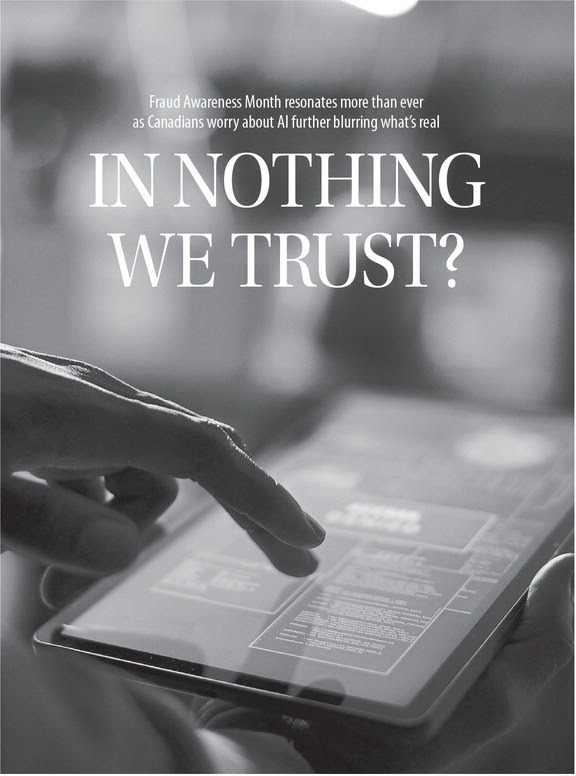
Fraud Awareness Month resonates more than ever as Canadians worry about AI further blurring what’s real
IN NOTHING WE TRUST?
Trust no one. It’s not just a motto of conspiracy theorists.
Rather, the statement is arguably the broad take away of the messaging in March for Fraud Awareness Month in Canada.
Scams — in their many forms — have become so commonplace we almost take their prevalence for granted. Recent surveys point to Canadians’ acceptance of fraud’s ubiquity, amid growing unease and understanding of its sizable financial impact.
A recent TD survey found 46 per cent of Manitoba and Saskatchewan residents cite experiencing fraud attempts weekly or even daily.
More than half of respondents feel vulnerable, and 85 per cent say fraud is harder to detect, with about two-thirds noting artificial intelligence is making that ability to discern real from unreal much more difficult.
“We believe these numbers are understated because not everyone reports fraud so that tells me the problem is very widespread, impacting average Canadians,” says Tarundeep Dhot, vice-president, Canadian fraud management at TD Bank.
The Canadian Anti-Fraud Centre says Canadians lost more than $704 million to fraud in 2025. Since 2022, victims have lost an estimated $2.4 billion; losses are likely much higher given the centre estimates only about 10 per cent of all cases are reported.
Another recent survey, this one by RBC, points to Canadians not seeing the problem getting better. It found 54 per cent of respondents believe fraud is worse today than it was a year ago, and more than three in four note it is a bigger concern than ever.
“Clearly, clients are concerned, but on the other hand, we also see that clients are still quite vulnerable,” says Amit Sadhu, senior vice-president of credit and fraud management at RBC.
Many factors are at play for Canadians. The survey found 61 per cent of Prairies residents aren’t sure what they should be doing to protect themselves.
It’s hard to blame people; AI is making it harder to detect fraud. Even phishing attacks are more convincing.
Often involving fake emails from a financial institution, indicating an urgent issue like suspicious payments, phishing attempts to lure victims into clicking on the link in the email leading to a fake log-in page.
The victims try to log in, giving fraudsters usernames and passwords. The criminals then go to the real bank website, access the account and steal funds.
“These (phishing emails) look increasingly legitimate,” says Ben McCabe, chief executive officer of Bloom Finance, a provider of reverse mortgages.
Another popular form of fraud is the pay-to-get-paid scam.
“It is an email, text or call stating you have money in a lost account, and you just need to pay a customs charge to get it,” he says. “But then something else comes up requiring you to pay more to get the money released, and the sums victims pay keep rising.”
Bloom Finance has seen the impact of these scams on seniors, whereby victims often keep getting “deeper and deeper into paying, reluctant to believe what has happened is really a scam” McCabe says. “You have paid so much that you don’t want to believe it, right?”
Most of these scams are not new; they’re just more convincing because of AI. The psychological levers they pull have not changed. They prey on vulnerabilities, especially those of financially stressed individuals, says Mark Kalinowski, a financial educator with the Credit Counselling Society.
With deeply indebted consumers, “there is definitely a desire to get relief from their financial pressure,” he says.
One of the common frauds trapping financially struggling individuals is the employment scam. These consumers are approached online with a job offer, like a secret shopper opportunity.
The scammers provide them with a cheque to do the secret shopping, but the sum is far more than required. The scammer admits to making the error and asks the victim to remit the difference.
“Then, you wire transfer back the excess, and in the meantime, the cheque bounces,” Kalinowski says — and the victim is on the hook for the lost funds.
Fortunately, the means to stay safe remain much the same in the AI age.
First rule of prevention: beware of free money.
“There is no such thing” without strings attached, Kalinowski says about the old adage that if it is too good to be true, it probably isn’t.
RBC simply suggests ‘trust no one’ when it comes to unusual requests for personal information you have not solicited.
“Especially any request triggering strong emotions, prompting you to act quickly,” Sadhu says.
Fraudsters want people to act impulsively out of fear and greed. That’s why stopping and giving yourself time to think before acting is so important to avoiding scams.
“Ask someone that you trust for help,” he adds. This speaks to having a countermeasure many Manitobans could use, especially seniors — at risk of the ‘granny scam’ whereby a fake grandchild calls, allegedly needing a money wire transfer to help get out of a jam.
Having a “trust password” known by only the family can stop this scam in its tracks, whereby the grandparent can ask the so-called grandchild for the password to verify their identity.
The problem is in Manitoba less than a quarter of respondents have a password, RBC’s poll reveals.
Another preventative tip is sharing less on social media. Fraudsters increasingly social engineer scams using information from people’s social media, even using videos to create fake ones and impersonate their voices, Dhot says.
“Five years ago, doing that (scam) would have been very challenging,” he says. “Now, you have apps where all it takes is a few seconds to recreate someone’s voice.”
Joel Schlesinger is a Winnipeg-based freelance journalist
joelschles@gmail.com