Prior to its acquisition by Royal Bank of Canada (RBC), HSBC Bank Canada had specific online transfer thresholds set up for consumers:
- Online Banking Wire Transfer Limit: The standard daily limit for self-serve transfers/wires initiated through HSBC Canada’s online banking portal or mobile app was $50,000.
- Higher Tier Authorizations: For amounts exceeding $50,000 up to $150,000, users could initiate the transfer online, but required a phone authorization call to customer service to complete the transaction.
- Interac e-Transfer Limits: For standard domestic e-Transfers, the limit was lower, capped at $7,000 per day.
- HSBC Global Transfers: For transfers between a customer’s own linked international HSBC accounts (Global View), the limit was up to $100,000 USD per day.
We are now seeing new Canadian regulations coming in that will allow financial institution customers to set their own threshold limits as a defensive mechanism measure to prevent them from losing far more than the threshold limit they establish.
This is a message to Canadian financial institutions that if you are not willing to set thresholds for vulnerable consumers as former HSBC Bank Canada did, customers will be able to do that on their own volition. Hopefully this is also a signal to banks and credit unions that introducing threshold limits on consumer withdrawals and what can end up being high risk wires to international locations, indirectly or directly, is reason to do more to verify that they are legitimate (e.g., confirmation or verification of payee).
Why should we be concerned? Fraudsters will completely drain a bank account, if possible, as there’s no limit to their greed to exploit an innocent victim of removing their money from them. While threshold limits are no silver bullet, it does slow down the money transfer and can enable both the consumer and financial institution to pause and think about what is happening before proceeding further the next day with another major money transfer.
While the above thresholds are more outward in their manifestation to consumers, financial institutions have the ability within their own internal structure workflow and anti- money laundering framework to set thresholds to alert them to suspicious or potentially very costly transactions to them and their customers.

Roshan Kumar
Financial Crime Technology Leader | AI | Actimize | OFSAA | AML | Transaction Monitoring | Data Platforms | Digital Transformation
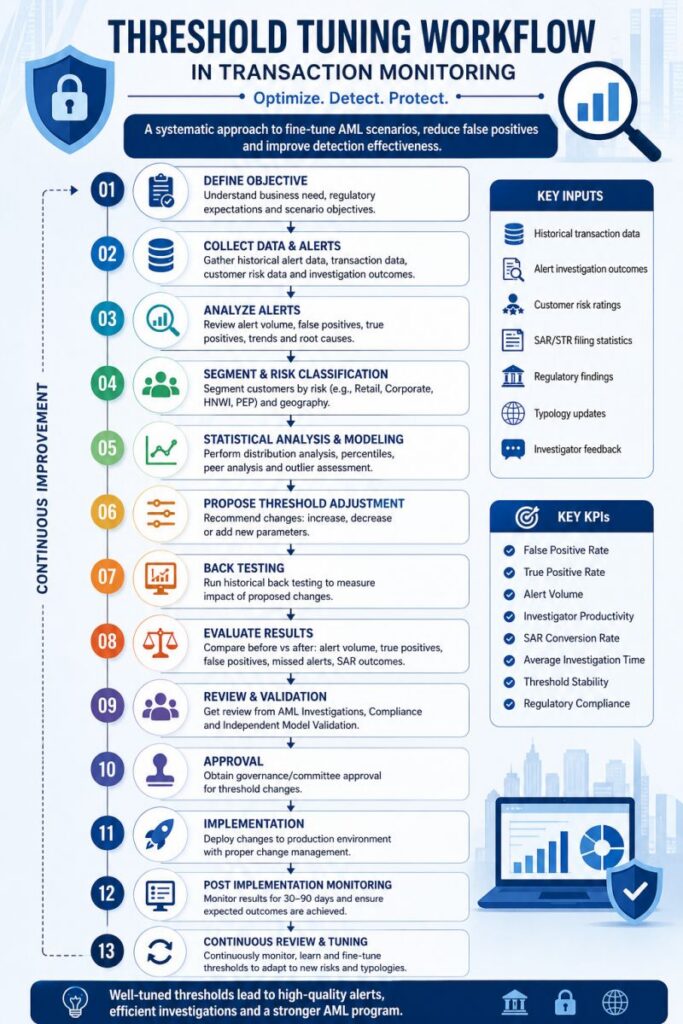
🚨 Threshold Tuning: The Hidden Engine Behind Effective Transaction Monitoring
A transaction monitoring scenario is only as effective as its thresholds.
If thresholds are set too low, investigators are overwhelmed with false positives.
If thresholds are set too high, genuine suspicious activity may go undetected—creating significant regulatory and financial crime risk.
An effective threshold tuning process should include:
✅ Review historical transaction and alert data
✅ Analyze false positives and true positives
✅ Segment customers by risk (Retail, Corporate, PEP, HNWI, Geography)
✅ Perform statistical analysis and back-testing
✅ Validate proposed changes with Compliance and AML Investigations
✅ Obtain governance approval before deployment
✅ Monitor post-implementation performance and continuously refine thresholds
The goal isn’t to generate more alerts—it’s to generate the right alerts.
A well-tuned transaction monitoring program helps financial institutions:
* Reduce false positives
* Improve investigator productivity
* Increase detection of suspicious activity
* Strengthen regulatory compliance
* Adapt quickly to emerging money laundering typologies
How does your organization approach threshold tuning?
Do you rely on periodic reviews, data-driven analytics, AI-assisted optimization, or a combination of these? Share your experience in the comments.
#AML #TransactionMonitoring #FinancialCrime #AntiMoneyLaundering #ThresholdTuning #Actimize #OracleFCCM #Mantas #Compliance #RiskManagement #Banking #RegTech #AI #DataAnalytics #FinancialServices