Generating reports for regulators is part of a financial institution’s obligations but as stated here, to detect and prevent fraud you need to be closely examining fraud risk indicators and take decisive action to confront them every day in your operation.
What lies behind the numbers and how can you get in front of it to show measurable success and improvement in the number of fraud attacks you have stopped from becoming another fraud report after the fact.
As cited below, “start identifying the conditions that make fraud more likely”. Moreover, “The ultimate goal is not to become better at explaining fraud losses after they occur. It is to become better at recognising vulnerabilities and intervening before those losses happen.”

📌 Fraud Risk Indicators: Are We Detecting Fraud — or Preventing It?
One of the biggest challenges in fraud risk management is that organisations often measure what has already gone wrong rather than identify the warning signs that something may be going wrong.
Fraud losses are recorded. Investigations are reported. Cases are counted. Controls are reviewed.
All of these activities have value, but they may tell us more about yesterday’s failures than tomorrow’s threats.
This is where effective Fraud Risk Indicators (FRIs) can make a real difference.
The objective is not simply to track the number of fraud incidents. It is to identify patterns, anomalies and vulnerabilities that could signal an emerging fraud risk before financial losses, reputational damage or regulatory consequences materialise.
For example:
🔹 A rising number of unusual transactions may be more informative than the total number of fraud cases already confirmed.
🔹 Repeated overrides of approval controls may reveal a growing vulnerability before that weakness is exploited.
🔹 Unusual changes in vendor bank details, combined with weak verification practices, may signal an increased exposure to payment fraud.
🔹 Increasing access privileges or excessive segregation-of-duties exceptions may indicate opportunities for internal fraud.
Of course, no single indicator proves that fraud is occurring. The real value lies in combining relevant indicators, understanding their context and investigating meaningful warning signals.
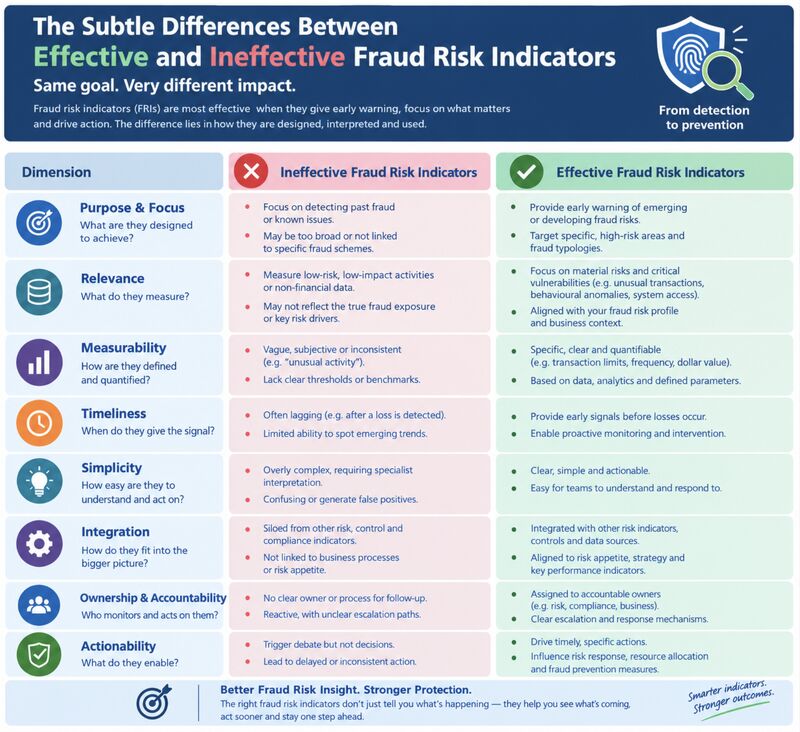
This is why effective FRIs must be relevant, measurable, timely, clearly owned and linked to specific actions.
An indicator that generates a dashboard entry but triggers no investigation, escalation or preventive response is unlikely to deliver its full value.
The accompanying infographic highlights eight important dimensions that distinguish effective Fraud Risk Indicators from ineffective ones.
The underlying message is simple:
– Fraud risk management becomes much more powerful when organisations move beyond counting fraud events and start identifying the conditions that make fraud more likely.
– The ultimate goal is not to become better at explaining fraud losses after they occur. It is to become better at recognising vulnerabilities and intervening before those losses happen.
💬 A question for risk, compliance and internal audit professionals: Are your fraud indicators genuinely providing early warning, or are they primarily reporting incidents after the event?
Financial Services Operations | Operations Management | Team Leadership | Risk & Compliance | Quality Assurance | Process Improvement
One thing I’ve come to appreciate through fraud investigations and QA is the difference between recognizing a recurring issue and actually addressing it. Sometimes the warning signs are there, but understanding why they continue to appear can be just as important. It’s interesting how much can be learned by looking at what happens after a risk is identified.