An obvious place to start on this LinkedIn post is financial institutions need to assess their clients/members profile first if they are going to evaluate their potential risk to be targets of fraud and/or be an accomplice in one through the account they have set up. It also cannot be static as ongoing monitoring must be a prerequisite to any financial institution concerned about meeting their regulatory obligations and requirements to detect and prevent money laundering.
As pointed out here, this does not mean the customer is directly involved in an illegal activity, but they can certainly end up being part of one unknowingly as a result of being targeted by a fraudster.
These categorizations of customers are done for the protection of the customer, not just the financial institution. If the customer is a bad actor, they should be uncovered and not allowed to continue using an account for criminal purposes.
The key takeaway here, as stated below, is to uphold the integrity of the financial system. A risk-based approach is warranted and justified given how much fraud we are seeing happen through our financial institutions.

Ryan Carel Aquino
Retail Banking Professional | KYC • AML • Customer Due Diligence | 9 Years of Banking Experience
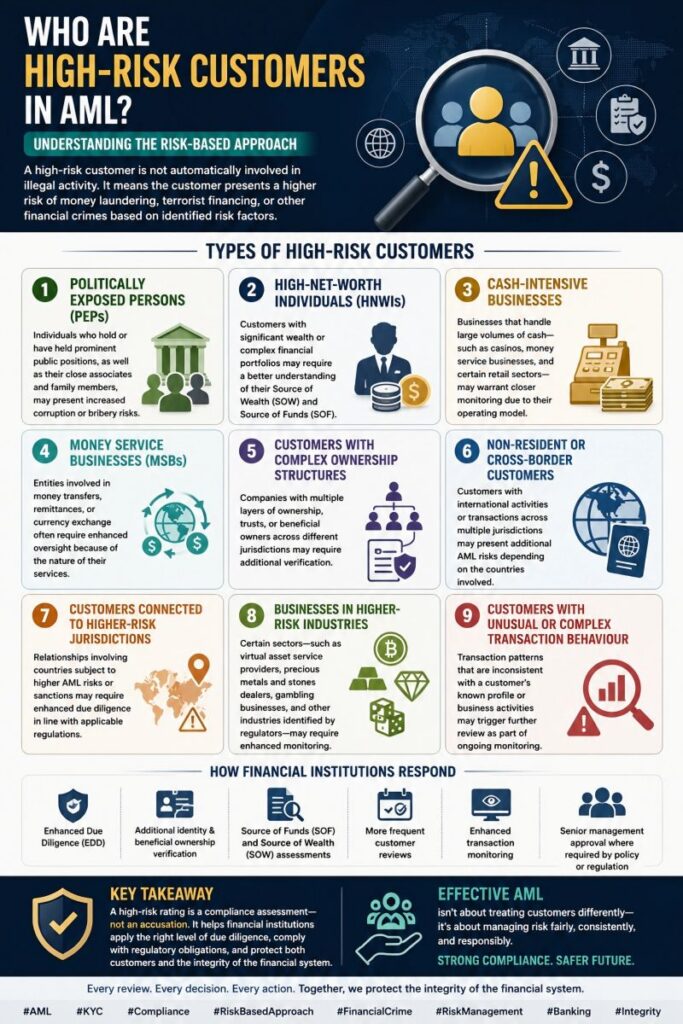
⚖️ Who Are High-Risk Customers in AML? Understanding the Risk-Based Approach
In Anti-Money Laundering (AML), a high-risk customer is not someone who is automatically involved in illegal activity.
Instead, it means the customer presents a higher risk of money laundering, terrorist financing, or other financial crimes based on factors identified through a financial institution’s risk assessment. As a result, additional due diligence and ongoing monitoring may be appropriate.
Here are some common categories of higher-risk customers:
🔹 Politically Exposed Persons (PEPs)
Individuals who hold or have held prominent public positions, as well as their close associates and family members, may present increased corruption or bribery risks.
🔹 High-Net-Worth Individuals (HNWIs)
Customers with significant wealth or complex financial portfolios may require a better understanding of their Source of Wealth (SOW) and Source of Funds (SOF).
🔹 Cash-Intensive Businesses
Businesses that handle large volumes of cash—such as casinos, money service businesses, and certain retail sectors—may warrant closer monitoring due to their operating model.
🔹 Money Service Businesses (MSBs)
Entities involved in money transfers, remittances, or currency exchange often require enhanced oversight because of the nature of their services.
🔹 Customers with Complex Ownership Structures
Companies with multiple layers of ownership, trusts, or beneficial owners across different jurisdictions may require additional verification.
🔹 Non-Resident or Cross-Border Customers
Customers with international activities or transactions across multiple jurisdictions may present additional AML risks depending on the countries involved.
🔹 Customers Connected to Higher-Risk Jurisdictions
Relationships involving countries subject to higher AML risks or sanctions may require enhanced due diligence in line with applicable regulations.
🔹 Businesses in Higher-Risk Industries
Certain sectors—such as virtual asset service providers, precious metals and stones dealers, gambling businesses, and other industries identified by regulators—may require enhanced monitoring.
🔹 Customers with Unusual or Complex Transaction Behaviour
Transaction patterns that are inconsistent with a customer’s known profile or business activities may trigger further review as part of ongoing monitoring.
💡 Key takeaway:
A high-risk rating is a compliance assessment—not an accusation. It helps financial institutions apply the right level of due diligence, comply with regulatory obligations, and protect both customers and the integrity of the financial system.
#AML #KYC #CDD #EDD #RiskBasedApproach #FinancialCrime #Compliance #RiskManagement #SourceOfFunds #SourceOfWealth #Banking