A good reminder here on how anti-money laundering professionals should be willing to share on platforms such as LinkedIn, as many do already, because others will without doubt benefit from their insights, knowledge and field experience.
Sharing expertise and knowledge on the fundamentals of AML and strong compliance can only help other professionals refocus and double their efforts to prevent fraud and safeguard their financial institution’s reputation by doing everything to protect the customers they have earned the trust of to manage their money responsibly.

Ratnaa Singh
Passionate AML/KYC Professional | Committed to Fighting Financial Crime | Enabling Strong Compliance Cultures & Capability Building
Hello everyone,
Today, I want to revisit the foundation of Financial Crime Compliance- Anti-Money Laundering (AML).
After spending more than two decades in banking and financial crime compliance, I’ve realized that the biggest challenge is not the lack of regulations, it’s the lack of strong fundamentals.
Many professionals focus on advanced concepts, but effective AML begins with understanding the basics and applying them consistently.
Here are some key AML concepts every Financial Crime Compliance professional should know:
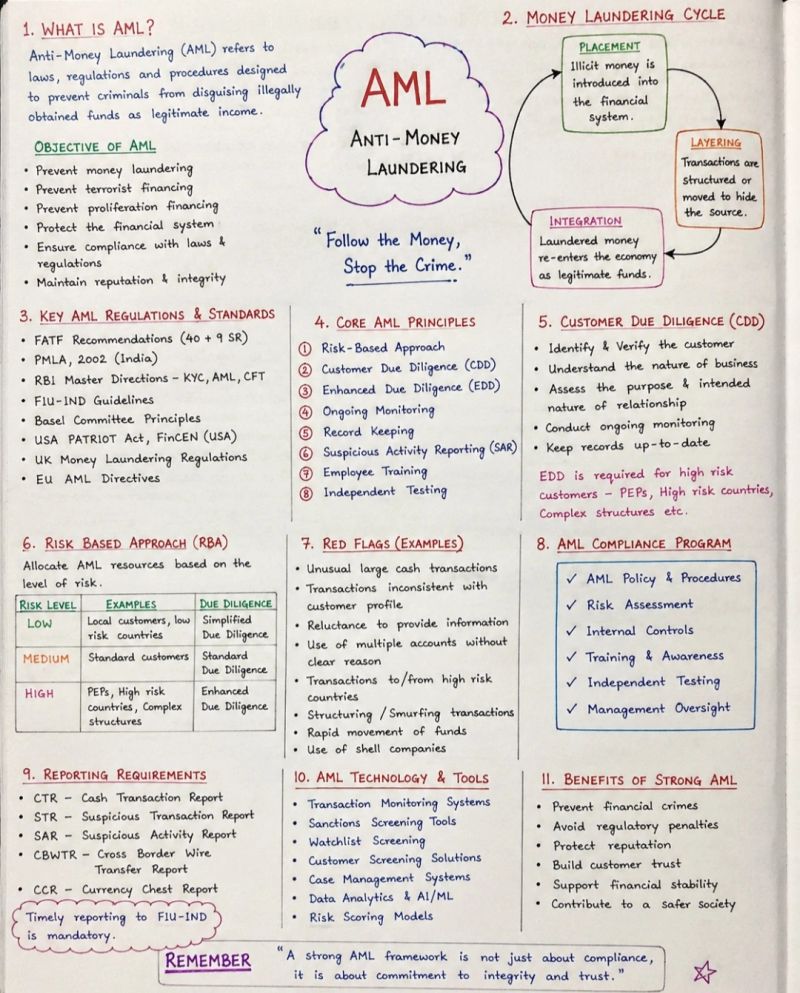
🔹 What is AML?
AML is a framework of laws, regulations, policies, and controls designed to prevent criminals from disguising illegally obtained funds as legitimate money.
🔹 Objectives of AML
✔ Prevent Money Laundering
✔ Combat Terrorist Financing
✔ Protect the integrity of the financial system
✔ Ensure regulatory compliance
✔ Safeguard an institution’s reputation
🔹 The Three Stages of Money Laundering
1️⃣ Placement – Introducing illicit funds into the financial system.
2️⃣ Layering – Creating complex transactions to hide the source of funds.
3️⃣ Integration – Reintroducing the laundered money into the economy as seemingly legitimate funds.
🔹 Core Pillars of an Effective AML Framework
✔ Customer Due Diligence (CDD)
✔ Enhanced Due Diligence (EDD)
✔ Risk-Based Approach (RBA)
✔ Ongoing Transaction Monitoring
✔ Sanctions & Watchlist Screening
✔ Record Keeping
✔ Suspicious Transaction Reporting (STR/SAR)
✔ Independent Testing & Audit
✔ Employee Training and Awareness
✔ Strong Governance and Tone from the Top
🔹 High-Risk Indicators
• Unusual transaction patterns
• Large cash deposits without economic purpose
• Frequent international fund transfers
• Transactions involving high-risk jurisdictions
• Complex ownership structures
• Shell companies
• Sudden changes in customer behaviour
• Structuring (Smurfing) to avoid reporting thresholds
🔹 Why AML Matters
A strong AML programme is not just about complying with regulations,it protects customers, strengthens trust, reduces financial crime, and preserves the reputation of financial institutions.
As leaders, our responsibility extends beyond implementing policies. We must build a culture where compliance is understood, valued, and embedded into everyday decision-making. Strong leadership, continuous learning, and collaboration are essential to staying ahead of increasingly sophisticated financial crimes.
I feel and understand, knowledge becomes valuable only when it is shared. I hope these notes help professionals, students, and anyone interested in Financial Crime Compliance strengthen their AML foundation.
What AML topic would you like me to cover next? Let me know in the comments.Follow Ratnaa Singh for such post.
#AML #AntiMoneyLaundering #FinancialCrimeCompliance #KYC #CDD #EDD #RiskBasedApproach #TransactionMonitoring #Sanctions #Compliance #RiskManagement #Governance #Leadership