
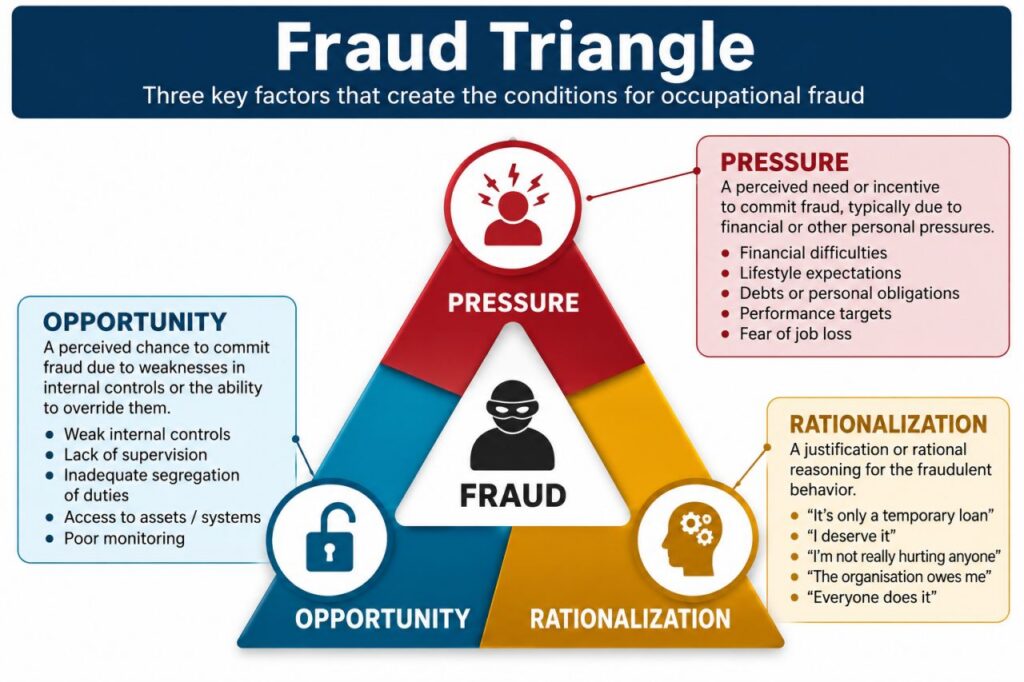
This financial crime and fraud investigator provides an interesting perspective on why good people can commit fraud from the inside of a financial institution. In saying that, he expounds on the need for a robust fraud risk management framework including “creating channels for early reporting and whistleblowing.”
There are key insights shared here by a certified fraud examiner. The Opportunity side of this fraud triangle is one financial institutions can control.
Financial Crime & Fraud Investigations | Fraud Risk | Internal Audit & Controls | Certified Fraud Examiner (CFE) | 10+ Years Banking
The Fraud Triangle: Why Good People Can Commit Fraud
Fraud rarely happens because of just one factor. In many cases, three conditions come together to create the environment for fraudulent behaviour:
🔴 Pressure — Financial difficulties, personal obligations, unrealistic targets, lifestyle expectations, or fear of failure can create the motivation.
🔵 Opportunity — Weak internal controls, inadequate segregation of duties, poor supervision, excessive system access, or ineffective monitoring can provide the means.
🟡 Rationalization — The individual convinces themselves that the act is justified:
“I’ll repay it.”
“I deserve it.”
“The organisation owes me.”
“Everyone does it.”
The important lesson for organisations is that fraud prevention cannot focus only on identifying dishonest individuals.
A strong fraud risk management framework should aim to:
• Reduce opportunities through robust internal controls
• Strengthen segregation of duties and access controls
• Improve transaction and employee monitoring
• Create channels for early reporting and whistleblowing
• Address excessive performance pressure and behavioural red flags
• Build a culture where ethical conduct is consistently reinforced
Fraud may require all three elements to converge, but organisations can actively disrupt the triangle by eliminating opportunity and detecting warning signs early.
In fraud risk management, prevention is not merely about controls—it is about understanding behaviour, incentives and vulnerabilities.
#FraudRiskManagement #FraudPrevention #FraudTriangle #FinancialCrime #InternalControls #RiskManagement #ForensicInvestigation #Banking #FraudAwareness
Dipankar Kundu
Turning Governance into Measurable Business Outcomes | Banking & BFSI Operations Leader | AI Governance | Operational Excellence | KYC • AML • Financial Crime • PMO • GCC Transformation | 20+ Years
VICTOR, CFE, SCR . The Opportunity leg is the one organisations can actually control. Pressure and rationalisation live inside a person. Opportunity lives inside the system.
Ran 20 years in BFSI operations, 713 FTEs across 20 lines of business. The frauds we caught were never the clever ones. They were the ones where segregation of duties had quietly eroded during a team reshuffle and nobody re-checked.
That is a governance failure, not a character failure. Does your framework audit the control state after the reshuffle, or only at design?
Parichay — free 30-minute call, no pitch:
Ajay Ranchod
Director RFC (Pty) Ltd – (FP) SA ; CFE ; OCFE
Donald Cressey’s foundational research on embezzlers was published in 1953 in his book Other Peoples Money: A Study in the Social Psychology of Embezzlement. Still as valid today as ever before…