Follow the money is often used to describe how you will eventually determine what is happening in a situation which does not meet normal practices of responsible money management and accounting. What are the irregularities and unusual patterns you are detecting through investigation of the money flow?
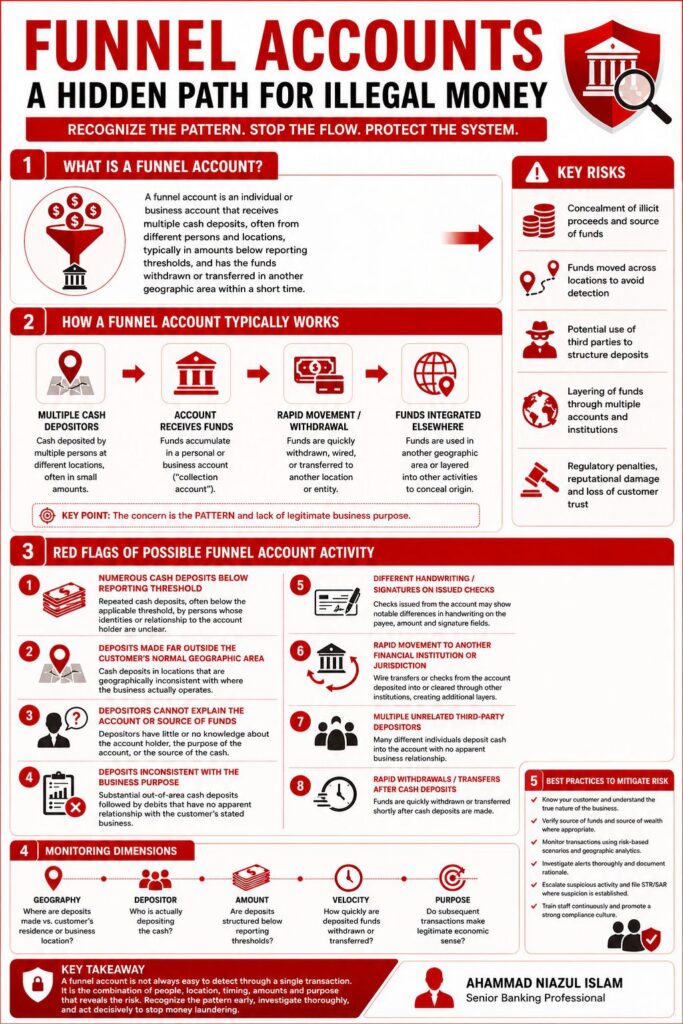
This LinkedIn post does a good job explaining what Mr. Islam refers to as funnel accounts. These accounts receive multiple deposits. Where is the money going?
What are our financial institutions doing to protect consumers from sending money to these funnel accounts that are being used for illegal purposes?

Ahammad Niazul Islam
Head of AML & DCAMLCO | AML/CFT Compliance | Financial Crime Risk Management | Banking Operations l Trade Finance
🔎 FUNNEL ACCOUNTS: WHEN TRANSACTION PATTERNS MATTER MORE THAN INDIVIDUAL TRANSACTIONS
In AML/CFT, sophisticated financial crime is rarely visible through a single transaction.
The risk often emerges when we connect the dots:
Who deposited the funds?
Where were they deposited?
Why were they deposited?
How quickly were they moved?
Where did the money ultimately go?
A funnel account is typically an individual or business account that receives multiple cash deposits, often across different geographic locations, followed by withdrawals or transfers elsewhere within a relatively short period.
🚩 Key indicators requiring closer attention
🔹 Multiple cash deposits by unrelated or unexplained third parties
🔹 Deposits made at branches geographically distant from the customer’s residence or business
🔹 Repeated deposits around or below applicable reporting thresholds
🔹 Depositors having limited knowledge of the account holder or purpose of the account
🔹 Cash activity inconsistent with the customer’s expected business profile
🔹 Rapid withdrawals, transfers or payments following cash deposits
🔹 Funds moving to unrelated beneficiaries, accounts, institutions or jurisdictions
🔹 Unusual cheque activity or indications that different persons may be operating the account
🎯 What should an effective transaction monitoring framework examine?
Geography + Depositor + Amount + Frequency + Velocity + Source of Funds + Purpose + Beneficiary
Looking at each transaction independently may miss the risk.
Looking at the relationship and transaction pattern can reveal the underlying financial flow.
🛡️ From a compliance leadership perspective
The objective should not be to generate more alerts.
The objective should be to generate better-quality alerts that identify meaningful risk.
That requires:
✅ Risk-based transaction monitoring scenarios
✅ Customer risk profile integration
✅ Geographic and branch-level analytics
✅ Third-party deposit analysis
✅ Source of Funds/Source of Wealth assessment where appropriate
✅ CDD/EDD escalation
✅ Quality investigation and documented rationale
✅ Effective STR/SAR decision-making where suspicion is established
Most importantly, a red flag is not proof of money laundering. It is an indicator requiring contextual analysis and appropriate investigation.
The real value of AML transaction monitoring lies in moving from:
Transaction Monitoring → Pattern Recognition → Risk Assessment → Investigation → Appropriate Action
💡 Financial crime detection is ultimately about connecting the dots before the money disappears through the next layer.
hashtag#AML hashtag#CFT hashtag#FinancialCrime hashtag#FunnelAccount hashtag#TransactionMonitoring hashtag#AMLCompliance hashtag#CDD hashtag#EDD hashtag#KYC hashtag#STR hashtag#SAR hashtag#RiskManagement hashtag#FinancialCrimeCompliance hashtag#Banking hashtag#ComplianceLeadership