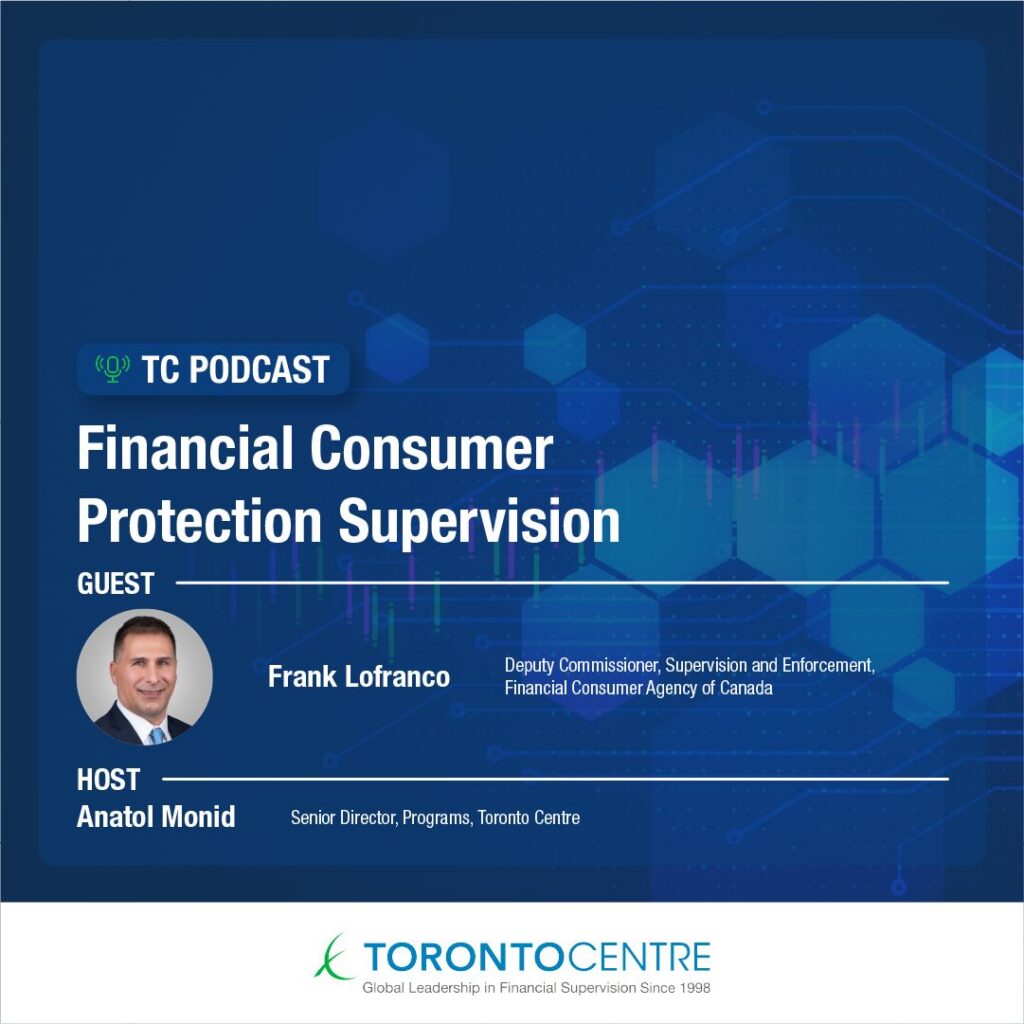
As podcasts gain greater currency in communicating key issues and engage important industry/government leaders on various topics of interest, this LinkedIn post provides a podcast of an interview with the Deputy Commissioner of Canada’s Financial Consumer Agency of Canada (FCAC). You can also link to the transcript if you prefer to read it.
Frank Lofranco’s responsibility for FCAC is supervision and enforcement. The podcast places emphasis on consumer protection and how FCAC uses its central role in ensuring financial institution compliance achieves positive outcomes for financial consumers.
For starters, this podcast was inspired by comments Lofranco stated prior to it being conducted.
For us, the North Star is really outcome-oriented. It’s about financial consumers benefiting from the consumer protections they are to be afforded. And they are afforded those protections for the purposes of achieving positive financial outcomes, and that does not happen without compliance.
This remark as a regulator is certainly intended in Canada’s case to address and overcome what some may perceive and believe is ” a lack of consumer protection or market conduct supervision.” As a result, it “increases the risks to consumers and businesses, such as the risk of financial loss from unfair or deceptive acts or practices.”
In the simplest of terms, the FCAC’s mission is to foster consumer trust in financial institutions and consumer confidence in Canada’s financial system. And it does this by protecting financial consumers and helping them make informed financial decisions.
Here are some key excerpts from Mr. Lofranco’s response to the questions directed to him from podcast host Anatol Monid of the Toronto Center.
From a mandate perspective, we carry out our mandate in two ways. First, as a regulator, we supervise the compliance of banks and other federally regulated financial institutions with consumer protection requirements. Those might be said in legislation, codes of conduct, or even public commitments. And this actually includes new and upcoming requirements on banks to help combat fraud, which as you’re no doubt aware, is a more complex issue, growing in complexity and growing in its global nature as well. Within our mandate, we also advance financial literacy across the financial ecosystem
So, whether someone is paying a bill, renewing a mortgage, saving for retirement, or navigating a financial setback, our focus is ensuring consumers benefit from the protections they are afforded and benefit from reliable information to make financial decisions and achieve positive financial outcomes.
I think it’s important to note, Anatol, that we do not do this alone. Our partners are central to everything we do. In particular, the Office of the Superintendent of Financial Institutions (OSFI), which is responsible for prudential regulation. Our role very much complements OSFI’s mandate by focusing on consumer protection and market conduct.
If we consider the introduction of the internet, which soon afterwards enabled online banking, followed by the introduction of debit cards and then e-transfers as a step into electronic banking, we’ve now seen the rise of digital banking and even have digital only banks in our financial marketplace.
Again, in the case of FCAC, our North Star has positive financial outcomes for consumers. In practical terms, this means we expect consumers to benefit from reliable, consistent protection. At the federal level, those protections include a series of obligations on banks and other entities, such as providing clear information, offering appropriate products, obtaining consumers’ express consent in writing, maintaining effective, timely, and accessible complaint handling processes, and the compliance of regulated entities with their obligations is really the cornerstone of consumer protection.
When I look to put this as simply as possible, the perspective is that without effective compliance, even the most well- informed consumer is exposed to financial harm.
And as a final point, through our risk-based approach, we look to act early. One of the lessons learned that we’ve taken from our experiences in recent years is supervisors ought to be prepared to act and to act early. This posture can help get ahead of risks before they become widespread or systemic.
Ultimately, when this is well done, effective risk-based supervision appears to be intelligence-led, adaptive in its cadence, and firm in its expectations. So, by way of perhaps a bottom line, the goal is not just to keep pace with change, but to ensure that innovation in the financial sector consistently translates into better and safer outcomes for financial consumers.
Safe in its design” is an expression or a term that we pay a lot of attention to. And the expectation is that innovation and competition must include strong and consistent consumer protection. Across various innovations, from AI-driven advice to digital banking, the core questions remain, and we continually ask ourselves and raise these questions with industry and regulated entities.
Are there risks to consumers that they may be misled or confused? Are the products being developed appropriate to their needs? Are risks clearly disclosed and understood by consumers? In other words, the test is not how innovative a product is necessarily, but whether it can consistently deliver fair, transparent, and appropriate outcomes for consumers. My point is that innovation and competition alone do not guarantee positive financial outcomes for consumers.
I would say that from our experience, those that are able to innovate and compete with minimal regulatory friction are those that treat consumer protection as a strategic imperative, not as a compliance obligation. These are institutions where consumer protection does not sit at the margins. Rather, we see it embedded within their corporate strategies, sales and marketing strategies, risk management practices, and decision-making at every level within an institution. I’m happy to say that best practices are emerging.
We are investing a lot of time in enabling the financial literacy of Canadians. I would say at a high level, traditionally, financial literacy efforts have focused primarily on providing information so people can make better decisions. And yes, information and consumer education still matter.
Canadians need to understand core concepts like interest, fees, and credit, but our experience to date has been that knowledge on its own is not sufficient in a complex digital marketplace, and that we need to consider factors such as skills, confidence, and behaviors, which ultimately means embedding financial information, behavioral science, and education into how products are designed, explained, and offered, and ensuring consumers are clearly informed about the products they are considering.
Our research is showing that meeting people at the point of decision with just- intime information enables informed decision-making. And so ultimately thinking about financial literacy beyond information and understanding questions around skills, confidence and behaviors, and timely intervention.
But I should start by saying that from my perspective, industry is very much justified in calling for greater regulatory coherence across federal, provincial and territorial authorities in Canada. As regulators deliver on their respective mandates, we do see the challenges that can arise. Challenges such as overlapping expectations, differing supervisory approaches, and industry having to navigate compliance across multiple regimes simultaneously.
I would say at the federal level, we work through FISC, which is the Financial Institution Supervisory Committee, which provides a forum to share information, compare perspectives, and identify and address risks that cut across mandates. I often think of FISC as a kind of shared space, a home with multiple doors, and whatever door and issue enters, it can be brought to the FISC table for discussion. However, in addition, we are increasingly focused on deepening collaboration with provincial regulators, really moving from dialogue to supervisory alignment in the way that your question suggested.
For example, we recently became members of CUPSA, the Credit Union Prudential Supervisors Association. We have a working group on market conduct, and FCAC was very pleased to be invited to join that working group and are working closely alongside our regulatory provincial regulatory partners. The forum has already provided opportunities to share insights and align expectations in areas such as complaints handling, for example.
Lots to take in and absorb here from a very informed regulator from FCAC. Among the take-always from this podcast interview with Deputy Commissioner Frank Lofranco that should be well heeded by financial consumers and financial institution staff advising them is how crucial it is that Canadians understand the financial institution products they are using.
Are there safeguards built in that will protect them from being defrauded or at least warnings about using ones where there is no security of their money? If so, they then need to independently verify the legitimacy of the account they are sending money to in order to protect themselves from fraud.
New TC Podcast!
“Financial Consumer Protection Supervision,” is now available.
Listen here: https://shorturl.at/b0rmE
In this podcast, Frank Lofranco, Deputy Commissioner, Supervision and Enforcement at the Financial Consumer Agency of Canada | Agence de la consommation en matière financière du Canada, examines the growing importance of consumer protection in today’s financial system.
He discusses the development of risk-based market conduct supervision, the role of compliance in achieving positive consumer outcomes, and the steps financial institutions can take to build regulatory confidence when introducing innovative products and services. He also shares practical advice for regulators and supervisors responsible for designing and overseeing consumer protection frameworks.
Listen now to gain valuable insights.
Guest
Frank Lofranco, Deputy Commissioner, Supervision and Enforcement, Financial Consumer Agency of Canada | Agence de la consommation en matière financière du Canada
Host
Anatol Monid, Senior Director, Programs, Toronto Centre