Canada is just one of a number of countries and governments (e.g., US state governments
taking action against them) looking at doing something about banning or at least regulating
crypto ATM machines given how investigations like CBC shows how fraudsters are using
the machines to launder millions from Canadians.
The CBC fraud series on crypto ATMs revealed the extent of the problem and how, if not
outright bans of these machines, several jurisdictions are setting daily transaction limits
per customer. Companies running these crypto machines indicated to CBC
investigation journalists they themselves are taking steps on their own volition to prevent
their machines being used by fraudsters to launder money (i.e., stopped a $20,000
transaction going through his machine).
More investigations like CBC Toronto’s on crypto ATMs will help bring attention to the
problem of Canadian consumers being scammed and hopefully bring solutions to reduce
how much money is being lost to fraudsters.

Nicole Brockbank, Angelina King · CBC News · Posted: Apr 28, 2026 6:21 PM EDT | Last Updated: April 29
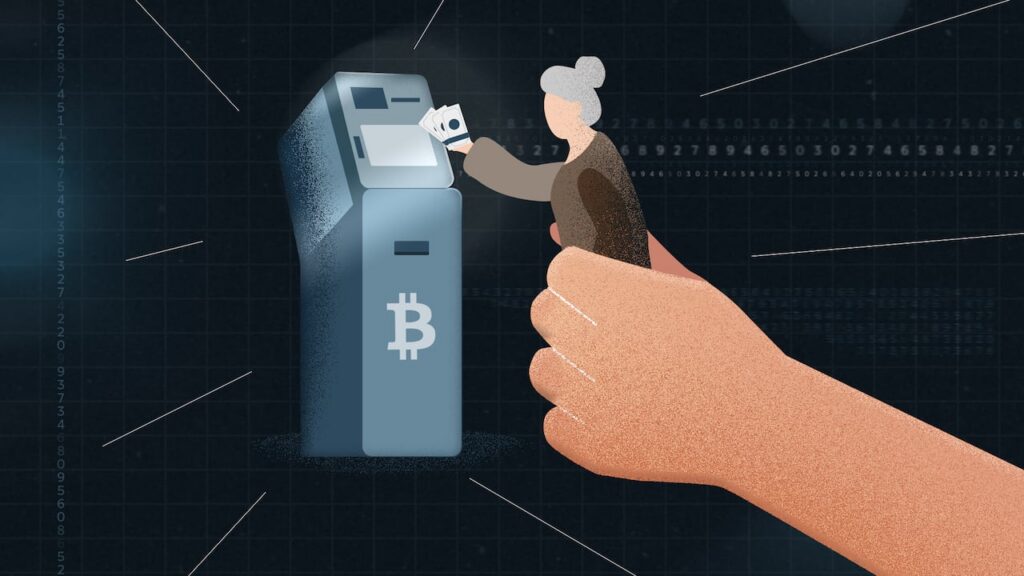
Crypto ATMs are touted as a low-barrier, convenient way to buy or sell crypto, but that’s
also what makes them appealing to fraudsters, a CBC News uncovered last year. (Brooke
Schreiber/CBC
The federal government announced it’s planning to ban crypto ATMs in order to protect Canadians from scammers using the machines to defraud victims.
The Liberals’ spring economic update on Tuesday referred to crypto ATMs as a “primary method for scammers to defraud victims and for criminals to place their cash proceeds of crime.”
Crypto ATMs might look a lot like a traditional banking machine, but instead of dispensing cash from your bank account, the majority of these machines allow customers to deposit cash and then convert it into cryptocurrency, like Bitcoin. Then, they can send it to a virtual wallet anywhere in the world.
The investigation revealed that these machines, which currently operate legally in Canada, have become the main vehicle fraudsters use to get money from scam victims across the country. Canada’s financial intelligence agency, FINTRAC, came to that conclusion in a February 2023 analysis of suspicious transaction reports submitted to the agency.
Crypto ATMs are touted as a low-barrier, convenient way to buy or sell crypto, but that’s also what makes them appealing to fraudsters, CBC’s investigation found.
Funds are sent quickly, a bank account isn’t required, most transactions only require a phone number if depositing under $1,000 and, unlike a bank, there’s no human interaction or teller trained to recognize a fraud unfolding.
Canada has the most crypto ATMs per capita in the world, but currently has no industry-specific regulations. There are nearly 4,000 crypto ATMs across the country and more than 39,000 around the world.
Crypto ATMs are the main way fraudsters are getting money from Canadians, according to a federal report. The CBC’s Angelina King and Farrah Merali dive into the issue in the three-part series Feeding Fraud: The Crypto ATM Problem.
Last fall, CBC News requested interviews with both Finance Minister François-Philippe Champagne and FINTRAC to ask about what (if any) action they were taking to address crypto ATMs becoming the main vehicle fraudsters use to get money from Canadian scam victims.
Neither request was granted. But when asked on Parliament Hill about the lack of specific regulations in the wake of the FINTRAC report, Champagne did not address the agency’s finding, instead telling CBC the government is looking at all options to prevent financial crimes.
“This is something we’re looking at very carefully and very seriously,” said Champagne last fall.
Tuesday’s economic update does not include many details on the proposed ban of crypto ATMs.
Currently, the machines are regulated like any other money services business (MSB) in Canada, a designation that includes foreign exchange dealers, regular ATMs and money-transfer services, like Western Union. The government’s update does say the measure will ensure Canadians can still buy virtual currencies from “brick-and-mortar MSBs, while better protecting MSBs from illicit activity.”
Other jurisdictions have previously taken action to fight fraud using crypto ATMs.
The U.K. effectively banned the machines by creating a licensing infrastructure in 2021 that hasn’t issued any licences to operators. New Zealand is proposing a ban on the machines and Australia introduced daily transaction limits last summer following a major investigation from its financial intelligence agency and police services.
Peer countries are tightening regulations on crypto ATMs to fight fraud, so why isn’t Canada?
South of the border, half of U.S. states have proposed or implemented laws to impose measures like daily transaction limits per customer, caps on transaction fees and requirements that operators issue refunds to scam victims.
ABOUT THE AUTHOR
Nicole Brockbank
Reporter, CBC Toronto
Nicole Brockbank is a reporter for CBC Toronto’s Enterprise Unit. She digs up, researches and reports GTA-focused investigative and enterprise stories. nicole.brockbank@cbc.ca