As the headline states very clearly, a financial institution which receives and detects a
signal from its fraud prevention framework, must pay attention to it and do further
investigation before just acquiescing the customer request and wiring the money.
This is why beyond knowing your customer or KYC as it is commonly referred to in the
financial ecosystem parlance, you need to monitor transactions to determine if a signal
shows something to concern yourself enough to press pause and ask questions.
KYC and transaction monitoring can be seen as a one-two punch but to land effectively
they need to be followed and applied if a financial institution is serious about preventing
fraud.
Aspiring Finance Graduate | Seeking Entry-Level Opportunities in Finance, Banking and Accounting | Financial Crime | CDD/EDD | KYC/AML | Customer relationship | Back office | Fund Accounting
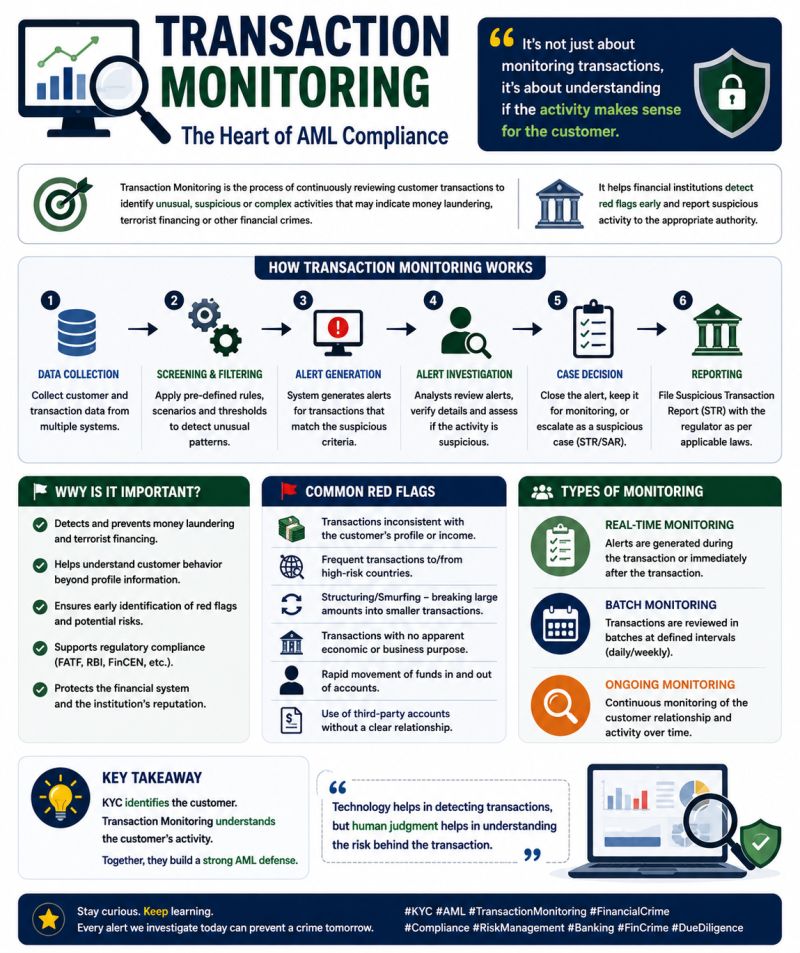
🚨 TRANSACTION MONITORING: How Banks Detect Suspicious Activity
Have you ever wondered how a bank identifies a transaction that doesn’t look right?
This is where Transaction Monitoring becomes an important part of a financial institution’s AML framework.
Transaction monitoring is the process of reviewing customer transactions to identify unusual, suspicious, or inconsistent activity that may indicate money laundering, terrorist financing, fraud, or other financial crime.
🔍 How does Transaction Monitoring work?
1️⃣ Data Collection
Customer and transaction data is collected from relevant systems.
⬇️
2️⃣ Screening & Filtering
Rules, scenarios, thresholds, and risk indicators are applied to identify potentially unusual patterns.
⬇️
3️⃣ Alert Generation 🚨
If activity matches a monitoring scenario, the system generates an alert for review.
⬇️
4️⃣ Alert Investigation 🕵️
An AML analyst reviews the customer’s profile, transaction history, expected activity, and other relevant information to determine whether there is a reasonable explanation.
⬇️
5️⃣ Case Decision
The alert may be closed with appropriate rationale, kept under monitoring, or escalated for further investigation.
⬇️
6️⃣ Reporting 📋
Where required and supported by the investigation, the institution may file a Suspicious Transaction Report (STR) or Suspicious Activity Report (SAR) with the relevant authority.
🚩 Common Transaction Monitoring Red Flags
🔸 Transactions inconsistent with the customer’s profile or expected activity
🔸 Rapid movement of funds through multiple accounts
🔸 Frequent transactions involving higher-risk jurisdictions
🔸 Potential structuring/smurfing activity
🔸 Transactions with no apparent legitimate economic purpose
🔸 Unexplained use of third-party accounts
💡 Simple Example
Imagine a customer whose profile indicates a regular monthly salary and normal household expenses.
Suddenly, their account receives multiple large-value transfers from unrelated parties and the funds are quickly transferred elsewhere.
The transaction itself may not automatically mean money laundering.
But the difference between expected activity and observed activity could generate an alert that requires investigation.
🎯 The key takeaway
KYC helps identify WHO the customer is.
Transaction Monitoring helps understand WHAT the customer is doing financially.
Together, they help financial institutions identify and manage potential financial crime risks.
And remember:
“An alert is not proof of suspicious activity — it is a signal that requires investigation.”
📚 KYC & AML Learning Series
I’m continuing to build my knowledge of KYC, AML, Transaction Monitoring and Financial Crime Compliance.
What do you think is the most important skill for an AML analyst — attention to detail, analytical thinking, or investigation skills? 👇
#KYC #AML #TransactionMonitoring #FinancialCrime #Compliance #AMLAnalyst #RiskManagement #Banking #KYCAML #DueDiligence #FinCrime #BankingJobs