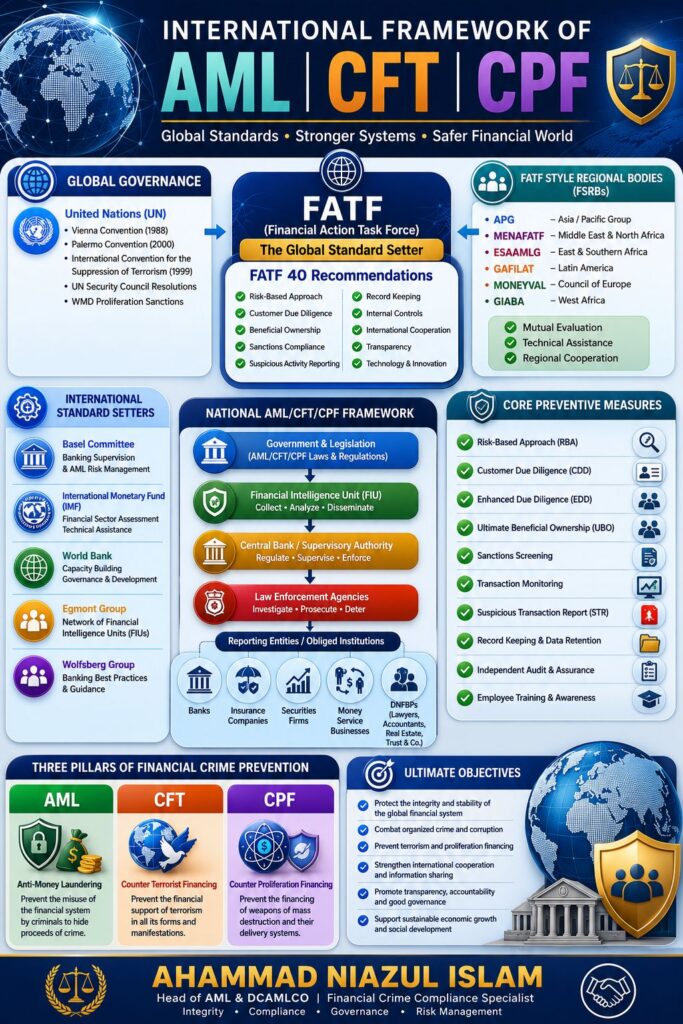
Having just posted a link to OECD’s June report on Protecting Consumers from Financial Scams and Frauds on this financial vulnerability blog, where a clear and defining recommendation was international collaboration and cooperation to fight the global scourge of fraud which respects no borders, this LinkedIn post by Mr. Islam, picks up on what OECD is recognizing in its report. it outlines the international AML, CFT and CPF framework.
He delivers a strong message as highlighted here.
Financial institutions play a critical role in safeguarding the global financial ecosystem. Success depends not only on technology and regulatory requirements but also on ethical leadership, sound governance, and a proactive compliance culture embedded throughout the organization.
As compliance professionals, our responsibility is to move beyond a “check-the-box” mindset and embrace financial crime risk management as a strategic business priority. Strong AML/CFT/CPF frameworks protect institutions, strengthen public trust, preserve financial stability, and contribute to global security.
Please check out his infographic at the bottom of this post.

Head of AML & DCAMLCO | AML/CFT Compliance | Financial Crime Risk Management | Banking Operations l Trade Finance
International AML, CFT & CPF Framework: Building a Safer Global Financial System
Financial crime continues to evolve at an unprecedented pace. Money laundering, terrorist financing, and proliferation financing increasingly exploit technology, cross-border transactions, and complex financial networks. As these risks become more sophisticated, a coordinated international response is no longer optional—it is essential.
The global AML/CFT/CPF framework provides the foundation for protecting the integrity of the international financial system. At its core, the Financial Action Task Force (FATF) establishes globally accepted standards through its 40 Recommendations, while organizations such as the United Nations, Basel Committee, IMF, World Bank, Egmont Group, and FATF-Style Regional Bodies work together to strengthen national frameworks and enhance international cooperation.
An effective AML/CFT/CPF regime extends well beyond regulatory compliance. It is built upon:
• A strong risk-based approach
• Robust Customer Due Diligence (CDD) and Enhanced Due Diligence (EDD)
• Beneficial Ownership transparency
• Effective sanctions screening
• Continuous transaction monitoring
• Timely Suspicious Transaction Reporting (STR)
• Strong governance, independent assurance, and a culture of compliance
Financial institutions play a critical role in safeguarding the global financial ecosystem. Success depends not only on technology and regulatory requirements but also on ethical leadership, sound governance, and a proactive compliance culture embedded throughout the organization.
As compliance professionals, our responsibility is to move beyond a “check-the-box” mindset and embrace financial crime risk management as a strategic business priority. Strong AML/CFT/CPF frameworks protect institutions, strengthen public trust, preserve financial stability, and contribute to global security.
I have developed the attached infographic to provide a concise overview of the international AML, CFT, and CPF framework for banking professionals, compliance officers, auditors, regulators, and students seeking a practical understanding of the global financial crime prevention architecture.
I welcome your perspectives. Which emerging AML/CFT/CPF challenge do you believe will have the greatest impact on financial institutions over the next five years?
hashtag#AML hashtag#CFT hashtag#CPF hashtag#FinancialCrime hashtag#Compliance hashtag#RiskManagement hashtag#FATF hashtag#FinancialIntelligence hashtag#Sanctions hashtag#KYC hashtag#CDD hashtag#EDD hashtag#Banking hashtag#Governance hashtag#AMLCompliance hashtag#FinancialCrimeCompliance hashtag#Leadership hashtag#BangladeshBank