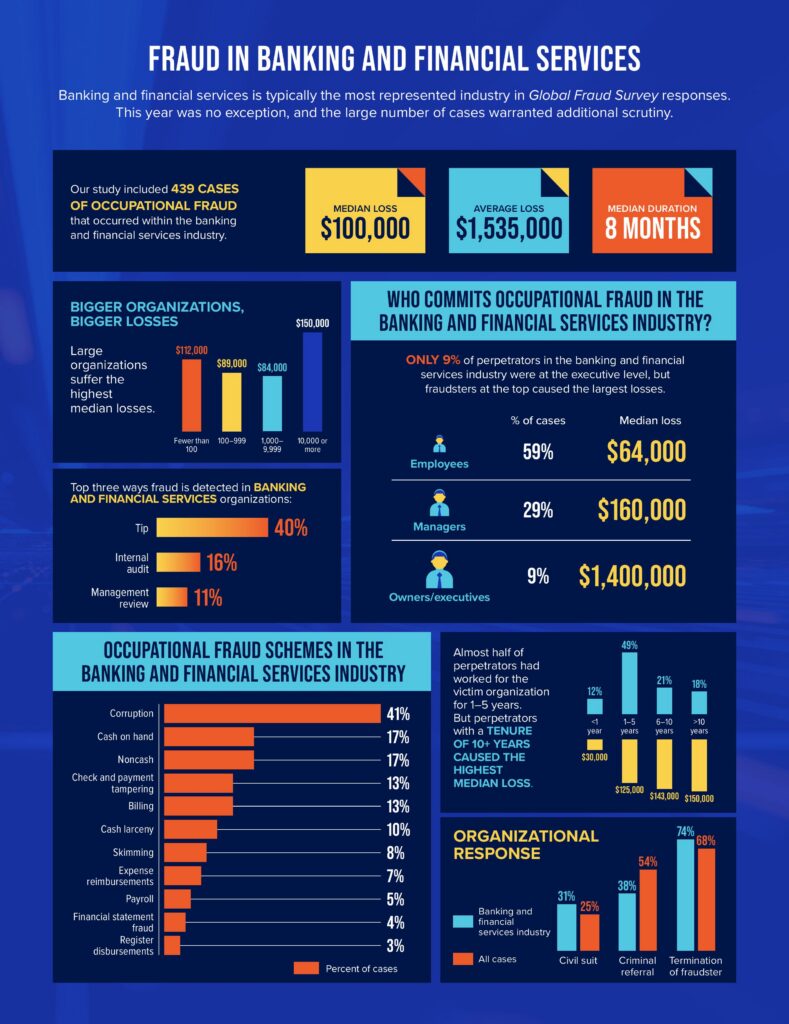
The Association of Certified Fraud Examiners (ACFE) releases a report on whistleblowing annually. 2026 is available now with the link provided below in the brief article. Given the focus of this blog, the infographic shown below is on Banking and Financial Services.
Whistleblowing does make a difference, and one good example is what Ontario is doing through its Ontario Securities Commission (OSC). The province has set up a whistleblowing awards program to encourage employees to come forward if they think something is not right, and it should be called out. When you click on the link you will see that in February 2024 the OSC awarded a whistleblower $1.5 million. As stated, it “allowed the OSC to act swiftly to protect investors from harm”.
Creating a culture of transparency where whistleblower tips are encouraged and anonymous within financial institutions and the financial services industry will help reduce insider fraud.
Defending Whistleblowers: Creating a Culture of Transparency Before the Tip Comes In
The ACFE’s Occupational Fraud: 2026 A Report to the Nations paints a clear picture: tip lines remain the most effective tool for detecting fraud, uncovering 43% of cases.
By ACFE Staff | July 2026 | Duration: 4-minute read
In a world where transparency often feels more like a buzzword than an actual practice, whistleblowers stand out as unsung heroes. They risk careers and livelihoods to ensure that organizations live up to their ethical standards. They expose corruption, fraud and misconduct, peeling back layers of secrecy to reveal the truth. But what happens when these truth-seekers are not protected?
The ACFE’s recently released Occupational Fraud: 2026 A Report to the Nations paints a clear picture: tip lines remain the most effective tool for detecting fraud, uncovering 43% of cases. Despite this, many organizations still lack effective protective measures for those willing to come forward.
For 30 years, the Report to the Nations has helped professionals, organizations and the public identify patterns, benchmark anti-fraud programs, and understand where and how controls break down. Over three decades, one key finding has not changed: In every edition of the report, tips have been the most common detection method.
Creating an Environment of Safety
A culture of integrity is fundamental to making whistleblowers feel secure. If employees do not believe leadership will protect them or are reluctant to speak up, they may remain silent. This culture must start from the top. When leaders genuinely embody the values they espouse and show they are not above scrutiny, they make honesty safe again.
Accessible and reliable reporting channels are essential, whether through third-party hotlines, web platforms or encrypted email. Allowing anonymity is crucial; no one should have to worry that their name will be linked to sensitive tips. Yet, even the best channels can be undermined if poorly executed. They should be intuitive, user-friendly and accessible 24/7 because fraud does not follow regular office hours.
Based on findings from the Report to the Nations, the use of web-based and online reporting mechanisms by whistleblowers has increased since 2018, while telephone hotlines, once the most common reporting method, have steadily declined. Organizations should actively maintain several channels for reporting fraud to give whistleblowers an opportunity to use a method that suits their situation.
Building Trust in the System
Education is crucial in empowering whistleblowers. Employees need to understand their rights and protections through regular, interactive training programs. Policies should be clear and devoid of legalese, ensuring everyone knows that reporting misconduct is not just allowed but encouraged and that retaliation will not be tolerated.
Investigations must be unbiased and above board. External oversight ensures impartiality while an empowered internal audit team should have the autonomy to investigate independently. Strong anti-retaliation measures should also be in place with strict consequences for those who try to silence whistleblowers. This demonstrates a zero-tolerance stance on retaliation.
Supporting and Celebrating Whistleblowers
A robust protection system also includes access to legal counsel and mental health support. Reporting can be incredibly stressful, so counseling services should be considered. Additionally, celebrating whistleblowers through recognition programs can help shift perceptions, recognizing them as the guardians of integrity they truly are.
Creating a safer environment for whistleblowers is not just about compliance; it is about fostering a workplace culture that values truth. Whistleblower protection must be more than a policy—it must be a commitment. The ACFE offers resources to help organizations build this culture, ensuring whistleblowers feel safe and empowered.
Leading by Example: Case Studies of Successful Whistleblower Programs
Organizations that have successfully implemented robust whistleblower programs provide a blueprint for others. Companies like Siemens and Volkswagen, which have faced significant scandals, have overhauled their internal reporting mechanisms and seen a positive shift in corporate culture. These organizations have invested in transparent communication, regular training and external audits to ensure the integrity of their processes. Their experiences highlight that while the journey toward a transparent culture is challenging, the rewards — enhanced trust, improved morale and a stronger reputation — are well worth the effort. By learning from these examples, other organizations can understand the tangible benefits of a robust whistleblower protection program and the critical role it plays in long-term success.