Mr. Walker in his LinkedIn post below not only provides a good example of a romance scam to make his point here but generates some good and supportive commentary below his post. They all generally agree with him that much more needs to be done to prevent clients from being scammed as the psychology of manipulation is powerful and must be recognized in the training of frontline financial institution staff who encounter clients under the influence of a fraudster.
There are a number of red flags to watch out of that they are aware of and should act on immediately. Ignoring or overlooking them will mean it’s too late to prevent a scam from being successfully carried out.

Andrew Walker
Exploring a public-interest approach to crypto scam reporting that could improve coordination between citizens, financial institutions, and regulators through standardized, structured blockchain intelligence.
Are financial institutions doing enough to protect their clients?
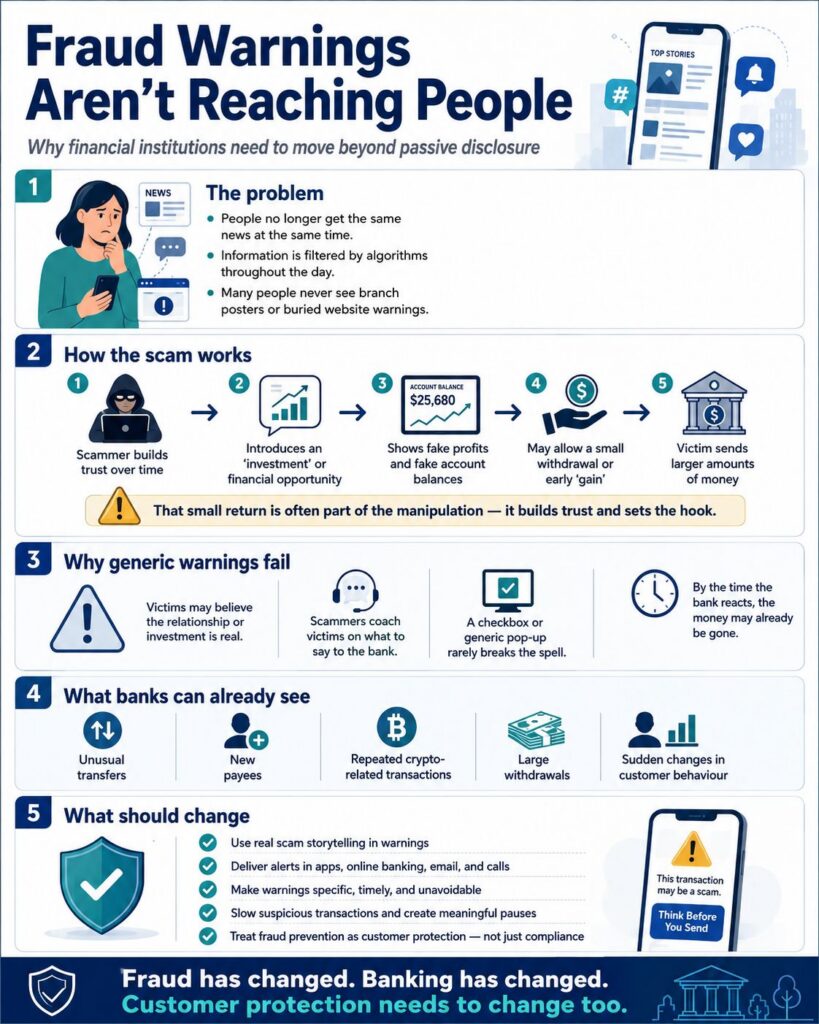
People no longer receive the same news at the same time.
Most people do not sit down every evening to watch a shared news broadcast. We receive information throughout the day, filtered by algorithms and shaped by what we already pay attention to.
That creates a serious problem for fraud awareness.
I had no idea what “pig butchering” or investment scams were until I became caught up in one myself. And I do not think I am alone.
Financial institutions may have posters in branches or fraud warnings on digital displays, but how many people regularly go into a branch anymore?
I see very few prominent warnings on my bank’s website about these types of scams. The information may technically exist somewhere, but it is not being delivered in a way that reflects how people actually bank, live, and consume information today.
Banks need to stop assuming that passive disclosure equals meaningful protection.
A warning buried on a website, a pamphlet in a branch, or a generic fraud notice in fine print is not enough.
These scams are not simple. They are not obvious. They are not just “bad decisions.”
A victim may believe they are in a genuine online relationship. The person may be kind, patient, attentive, and emotionally convincing. Over time, that person introduces an investment opportunity.
The victim may be shown fake profits, fake account balances, and professional-looking websites. In many cases, scammers even allow a small withdrawal or return early “gains” to make the opportunity appear legitimate.
That small return is not proof of legitimacy.
It is part of the manipulation.
It builds trust, lowers suspicion, and sets the hook for a much larger loss.
By the time a bank sees large transfers to a crypto platform, investment site, or unfamiliar recipient, the customer may already be emotionally invested, financially committed, and coached on what to say.
That is why vague warnings do not work.
If a financial institution believes a customer may be at risk, the warning should tell the story of the scam in plain language:
“This may be a scam. Fraudsters often build trust over weeks or months, show fake investment returns, allow small withdrawals to appear legitimate, coach victims on what to say to banks, and pressure them to send more money. Has anyone told you to keep this transaction secret? Has anyone told you what to say to us? Have you met this person in real life? Have you independently verified this investment?”
That kind of warning may break through in a way that a checkbox never will.
Fraudsters are proactive. They study human behaviour. They understand loneliness, financial stress, hope, embarrassment, and fear.
Too many financial institutions remain reactive. They intervene after the money has moved, after the customer has been deceived, and after the damage has already been done.
That is not good enough.
Financial institutions have access to enormous amounts of customer data. They can see unusual transfers, new payees, repeated crypto-related transactions, large withdrawals, and changes in customer behaviour.
Fraud prevention should be treated as a core customer-protection obligation, not simply a compliance exercise.
Banks should be expected to identify red flags, slow down suspicious transactions, provide specific warnings, escalate concerns, and create meaningful pauses before irreversible transfers are completed.
Fraud has changed.
Banking has changed.
News consumption has changed.
Customer protection needs to change too.
The current approach places too much responsibility on individuals to know about scams they may never have heard of, delivered through channels they may never see, while they are being targeted by criminals who are active, personal, and persistent.
That imbalance is unacceptable.
hashtag#Banking hashtag#FinancialServices hashtag#FraudPrevention hashtag#ScamAwareness hashtag#InvestmentFraud hashtag#PigButcheringScam hashtag#BankCompliance hashtag#CustomerProtection