Putting some focus here on consumers, especially vulnerable seniors, who are frequently targets of scams (e.g., romance, grandparent and investment schemes etc.), makes it incumbent on those working on the frontlines to learn from sources such as the AML Academy.
The post below on LinkedIn can be helpful too for consumers to glean what it is trying to impart to the ones dealing with fraud every day in their work. Why? Let’s use the word threshold as an example.
In Canada’s commitment to bring in a national anti-fraud strategy as part of its Bill C-15 (Budget Implementation Act) which was ratified this spring, there were amendments to the Bank Act to empower consumers to set limits on withdrawal amounts they can take from their account at one time. One reason this is significant is given how fraud schemes may involve a fraudster setting up a Canadian senior with a sizable nest egg to place and send it somewhere else on the false pretense that the investment may generate more income and present an opportunity to them that does not exist by leaving it in a bank at a low interest savings rate.
Reading between the lines from this AML Academy Journal post, there is reference to periodically checking your thresholds. While the word threshold is used more in what is necessary to file a Suspicious Transaction Report (STR) and/or Suspicious Activity Report (SAR) it also can be a key concept and provision not only for consumers setting limits on how much they are willing to withdraw at one time but on what a bank will allow through its own policies, or at least delay the transaction until the investigation proves it’s a legitimate one.
For example, in speaking to the Bank of America a few years ago about their rules around sending consumer wires, it was stated that if it is being done online and the wire instruction amount is higher than what the consumer has in their account it will be automatically rejected without any questions asked. Moreover, online or in-person, if the wire sum request is higher than $2,000, a more rigorous and thorough authentication process is undertaken to make sure the wire is legitimate. This was for within the US or internationally as bankers know money can be sent to an account down the street and it still may be one a fraudster was able to set up.
So, thresholds do matter for several reasons. They can also be a key determinant in triggering transaction monitoring alerts, the starting point of a robust AML process. An unusually high wire instruction amount for a person who has never requested one before, especially at a bank which has set a threshold amount on what the client can send at one time, should be enough to create an alert to ask questions and follow up on. The same can be said regarding the receiving end of a consumer wire. Why is this person sending so much money to this specific account when they have never done so before. What is the purpose?
In keeping with the discussion on thresholds, behavioral baselines where there is now deviation raise red flags for the key financial institution personnel to investigate and follow up on before allowing the transaction to be completed.
The best circumstance obviously is for the consumer to stop a scam from ever getting to the point where they think the process they are caught up in is legitimate, and they will contact their financial institution to initiate a transaction. Unfortunately, too many people are being duped into believing what they are doing is real and then being scammed. This is why in the UK they now reimburse innocent victims on what are called Authorized Push Payments (APPs) where the consumer is deceived into authorizing their banks to send money to what turns out to be a mule account set up by the fraudster.
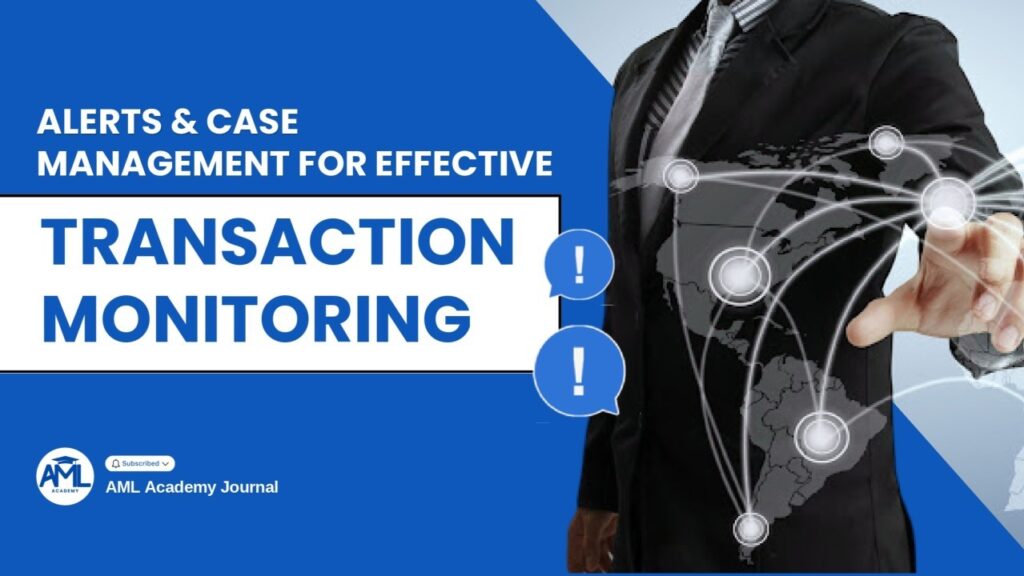
Alerts & Case Management for Effective Transaction Monitoring

AML ACADEMY
We offer CAMS Exam & CGSS Exam Mock test & online courses
In today’s complex financial ecosystem, transaction monitoring sits at the centre of any robust Anti-Money Laundering (AML) compliance framework. Yet, while automated systems generate millions of alerts each year, the true compliance value lies not in the volume of alerts but in how we manage, investigate, and resolve them.
Effective alert and case management bridges automated detection and meaningful regulatory outcomes, transforming raw signals into credible risk decisions.
1. Transaction Monitoring Alerts: The Starting Point
AML transaction monitoring systems continuously scan financial activity against risk rules, behavioural baselines and predefined red flags. These systems generate alerts when activities deviate materially from expected behaviour or match risk typologies such as structuring, velocity spikes, or unusual jurisdictional flows.
However, an alert is not a definitive suspicion of money laundering, it is an indication that something within the transactional dataset warrants human evaluation.
2. Triage & Initial Alert Review
The first critical step in alert handling is triage. Experienced AML analysts review alerts to:
- Understand why the alert fired (e.g. rule breach, pattern recognition, behavioural deviation)
- Assess customer context risk rating, product usage, historical behaviour
- Distinguish between true positives and false positives
This process requires both technical insight into alert logic and deep subject-matter knowledge no system, however sophisticated, can replace seasoned analytical judgment.
During this phase, analysts may close alerts that clearly reflect expected or explainable activity, documenting the rationale for audit readiness and compliance governance.
3. Case Escalation & Investigation Workflow
When an alert cannot be reasonably explained or is deemed potentially suspicious, it must be escalated into a case using a formal AML case management workflow. Here’s how a strong process typically unfolds:
Case Initiation
An alert transitions into a case, creating a structured task for deeper examination and establishing an audit trail from alert rationale to investigatory actions.
Investigation
Investigators then:
- Conduct a holistic review of transaction patterns and customer activity
- Request additional data or Request for Information (RFI) from business units or branches to clarify transaction purpose, source of funds, counterparty relationships, or customer intent
- Integrate all available KYC, CDD/EDD and behavioural data to form a complete picture
Clear, well-substantiated RFIs are essential, they not only support compliant case disposition, but also reduce regulatory pushback when questioned later.
4. Disposition, Documentation & Reporting
Once an investigation is complete, the case needs one of the following outcomes:
- Close with justification: If the activity is explainable within expected business patterns
- Enhanced due diligence (EDD): For higher-risk behaviours but not yet reaching SAR/STR filing thresholds
- SAR/STR submission recommendation: When the facts indicate potential money laundering or predicate offences
Documentation matters as much as the decision itself. Regulatory authorities increasingly focus on explainability not only that institutions file timely Suspicious Activity Reports (SARs), but that they can clearly articulate why a decision was made, what evidence was considered, and how the risk framework was applied.
5. Feedback Loop & Continuous Improvement
Effective alerts and case management is not static:
- Insights from case outcomes should feed back into model tuning and rule calibration
- False positives should prompt scenario refinement to reduce future noise
- Thresholds and detection logic should be periodically reviewed against evolving risks
This learning loop ensures the monitoring programme becomes more precise, more efficient, and more aligned with institutional risk appetite.