
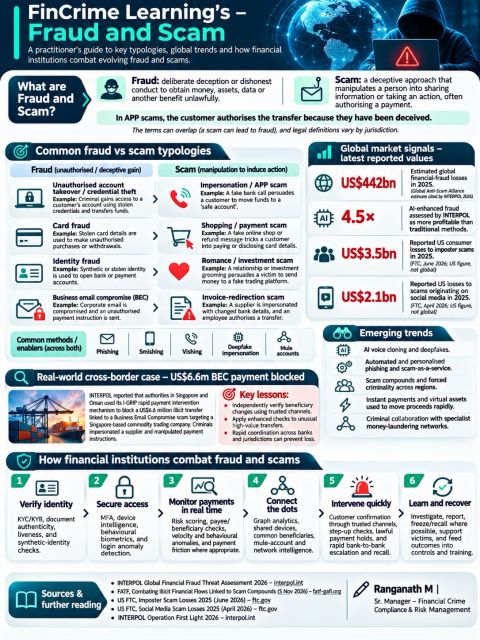
What is most germane here beyond the solid informational LinkedIn post and rich graphic from Mr. Ranganath on financial institutions fighting financial crimes are some of the excellent comments he generates from making this contribution to educate and inform LinkedIn subscribers on financial crime compliance.
For one, Mr. Balusubramaniam contends that scams are not distinct from fraud but “one of its manifestations”. He also correctly asserts that a “transaction can be technically authorised but fundamentally manipulated.” This gets into a discussion over how clear the dividing line is between an authorized and unauthorized payment when an unsuspecting victim would never authorize a payment if they knew it was not legitimate.
This is why more effort and incorporation of behavior analytics is being employed knowing how fraudsters are convincing bank customers to initiate a transaction without understanding how they are being manipulated to do it. For example, have they independently verified and are certain that the account they are sending money to is legitimate?
From a bank’s perspective and investigation, a customer they reveal as being under the influence of a fraudster may well be part of a scheme targeting other unsuspecting victims. What other money has been sent to the receiving account?
Back to Mr. Balusubramaniam, who concludes his response to this post with some insightful remarks.
The execution gap lies in connecting fraud intelligence, payment controls, mule- account detection and timely intervention. Customer education matters, but it cannot become a substitute for institutional responsibility.
The question is no longer simply whether the customer authorised the payment. It is whether the bank had reasonable opportunities to recognise and interrupt the deception.

Sr. Manager – Training & Quality | Financial Crime Compliance & Fintech Operations | 8 Clients | 2,500+ Workforce Portfolio | KYC • KYB • AML • TM • Sanctions | Building High Performance FCC Performance Center
🚨 A fraudster doesn’t need to hack your bank account anymore. Sometimes, all they need is to convince YOU to transfer the money.
The world of Financial Crime is changing rapidly. Fraud is no longer limited to stolen cards, phishing emails or unauthorised transactions. Criminals are exploiting artificial intelligence, human psychology, digital payment ecosystems and cross-border financial networks to execute increasingly sophisticated scams.
But do we truly understand the difference between fraud and scams – and, more importantly, how financial institutions are fighting them?
Here are some of the key developments every Financial Crime professional should understand.
🔹 Fraud vs. Scam – Understanding the difference
* Fraud involves deliberate deception to obtain money, assets or information unlawfully.
* Scams use manipulation and deception to convince victims to share information or authorise financial transactions.
🔹 Common fraud and scam typologies
* Phishing, Smishing and Vishing
* Authorised Push Payment (APP) and impersonation scams
* Investment and romance scams
* Business Email Compromise (BEC)
* Account takeover and identity fraud
* Invoice redirection and payment scams
🔹 Emerging global threats
* AI-generated deepfakes and voice cloning.
* Automated and personalised phishing campaigns.
* Organised scam compounds and cross-border criminal networks.
* Exploitation of instant payments and virtual assets.
* Increasing collaboration between fraudsters and specialist money-laundering networks.
🔹 How financial institutions are fighting back
The response requires more than traditional transaction monitoring. Financial institutions are increasingly strengthening their defences through:
1. Advanced KYC/KYB and identity verification.
2. Behavioural biometrics and device intelligence.
3. AI-powered fraud detection and real-time transaction monitoring.
4. Graph analytics and mule-network identification.
5. Rapid payment intervention and cross-border intelligence sharing.
6. Customer awareness, investigation and recovery mechanisms.
🔹 A critical learning for FinCrime professionals
A suspicious transaction is not always an isolated event. Behind a single payment could be a larger criminal network involving impersonation, social engineering, mule accounts and sophisticated money-laundering mechanisms.
Our ability to identify the wider picture, understand customer behaviour and make evidence-based decisions will define the effectiveness of future Financial Crime Operations.
#FinancialCrime #FraudPrevention #ScamAwareness #AML #FinCrime #FinancialCrimeCompliance #FraudDetection #APPFraud #BusinessEmailCompromise #AIFraud #CyberFraud #RiskManagement #KYC #TransactionMonitoring #ComplianceLeadership
Most Relevant
Manager at ICE-PAY
The network view is where fraud prevention and compliance have to connect. A suspicious transaction is rarely isolated, so KYC, transaction monitoring, and payment controls need to work from the same picture.
Sr. Manager – Training & Quality | Financial Crime Compliance & Fintech Operations | 8 Clients | 2,500+ Workforce Portfolio | KYC • KYB • AML • TM • Sanctions | Building High Performance FCC Performance Center
Kristina Fedorenko can’t agree more, we can effectively determine and combat fraud only when multiple teams align towards one common mission