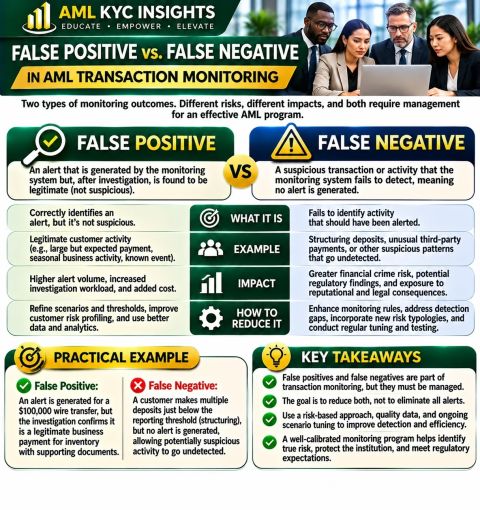
Whether they are false positives or false negatives, the key is to uncover and investigate unusual transaction activity. This LinkedIn post showcases all the alerts that can be generated through false positives while much fewer come from false negatives where suspicious activity may have existed, but no alert is generated.
The bottom line is you may have detection gaps that need to be addressed to detect and prevent fraud.
As stated below by Ms. Bowman,
Effective transaction monitoring requires the right balance between detection effectiveness and operational efficiency. That means quality data, appropriate scenarios, risk-based thresholds, ongoing testing, and continuous improvement.
MY KEY TAKEAWAY
A strong AML monitoring program isn’t measured simply by how many alerts it generates. It’s measured by how effectively it identifies activity that warrants investigation while managing unnecessary alerts.
Be alert to fraud attacks by implementing and refining a strong AML framework.

CAMS-Certified Banking Professional | Customer & Business Onboarding | Foundational CDD, KYC Documentation & Quality Review | Contract & Subcontract Support | Founder, AML KYC Insights
FALSE POSITIVE VS. FALSE NEGATIVE: WHICH IS MORE DANGEROUS IN AML TRANSACTION MONITORING?
In AML transaction monitoring, generating more alerts doesn’t necessarily mean a monitoring system is more effective.
And generating fewer alerts doesn’t automatically mean it’s working better.
The real question is: Are we detecting the right activity?
This is where understanding the difference between false positives and false negatives becomes important.
FALSE POSITIVE
A monitoring system generates an alert for activity that, after investigation, is determined not to be suspicious.
For example:
A business receives a $100,000 wire transfer that triggers an AML alert.
After reviewing the customer’s profile, invoices, and supporting documentation, the analyst determines that the payment is consistent with legitimate business activity.
The alert was generated, but the activity was not suspicious.
FALSE NEGATIVE
A monitoring system fails to identify activity that should have been detected.
For example:
A customer makes multiple cash deposits just below a reporting threshold.
The deposits form a potentially suspicious pattern, but the monitoring system does not generate an alert.
The activity may go unreviewed unless another control identifies it.
HERE’S WHY THE DISTINCTION MATTERS.
False positives can create:
• Excessive alert volumes.
• Increased investigation workloads.
• Higher operational costs.
• Analyst fatigue.
False negatives can create:
• Missed suspicious activity.
• Undetected financial-crime exposure.
• Potential regulatory and compliance consequences.
• Weaknesses in the institution’s monitoring effectiveness.
BUT HERE’S SOMETHING I THINK IS IMPORTANT:
Reducing false positives should never come at the expense of creating unacceptable detection gaps.
At the same time, generating thousands of low-value alerts doesn’t necessarily improve financial-crime detection.
Effective transaction monitoring requires the right balance between detection effectiveness and operational efficiency.
That means quality data, appropriate scenarios, risk-based thresholds, ongoing testing, and continuous improvement.
MY KEY TAKEAWAY
A strong AML monitoring program isn’t measured simply by how many alerts it generates.
It’s measured by how effectively it identifies activity that warrants investigation while managing unnecessary alerts.
QUESTION FOR AML AND FINANCIAL-CRIME PROFESSIONALS:
If you had to prioritize one challenge, which would concern you more: excessive false positives or undetected false negatives?
I’d love to hear your perspective.
#AML #TransactionMonitoring #FinancialCrimeCompliance #FalsePositives #FalseNegatives #AMLInvestigations #RiskManagement
Most Relevant

AML/KYC & Financial Crime Compliance | QA & Risk Controls | High-Risk Client Decisioning | Audit-Defensible Outcomes | FinTech & Global Banking | SME | CDD/EDD | Advisory
Absolutely, false negatives are a significant concern for me.
We know how much time and effort goes into reviewing false positive alerts, assessing relevant mitigating factors and documenting the rationale for appropriate closure.
However, while managing false positives is important for operational efficiency, we cannot overlook the potential consequences of false negatives. They can result in genuine red flags or suspicious activity going unidentified, potentially exposing institutions to significant money laundering and financial crime risks.
Ultimately, the objective should not just be to reduce false positives, but to strengthen the effectiveness of monitoring controls so that we don’t overlook what genuinely matters.

Chartered Accountant | Financial Controller | IFRS & Financial Reporting | Audit & Internal Controls | Tax | Multi-Branch & Remote Finance Management
False negatives pose the greater risk because suspicious activity may go undetected. However, reducing false positives is equally important to prevent alert fatigue and preserve detection effectiveness.