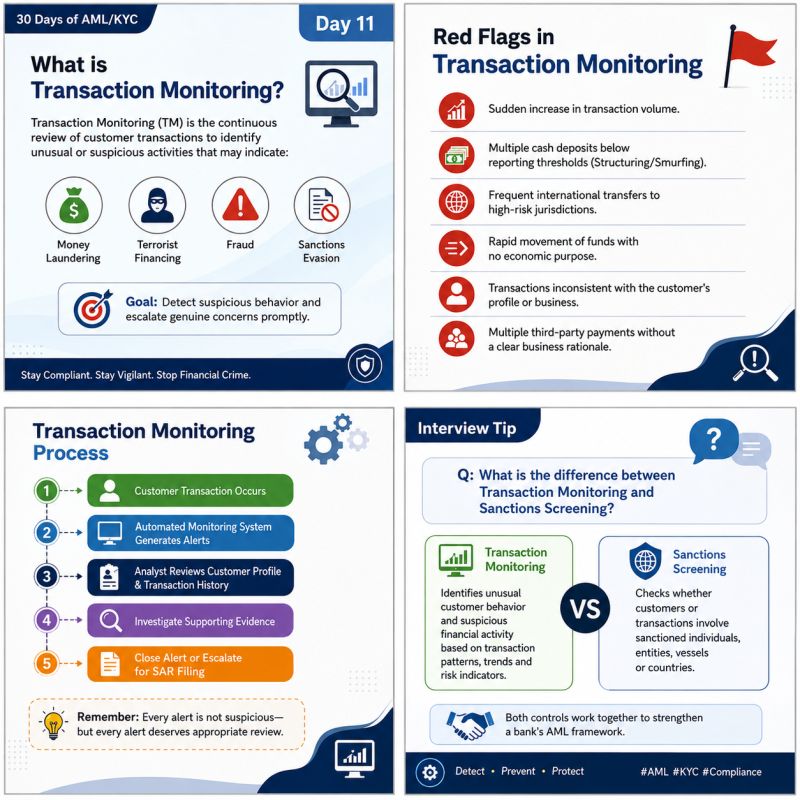
These two LinkedIn posts below focus on transaction monitoring. They are a reminder that transaction monitoring is a critical activity in helping financial institutions detect and prevent fraud. All of them should be doing it effectively and thoroughly by setting up their own robust ant-money laundering framework.
It must include excellent staff and regularly scheduled staff training on how to understand and see why a transaction is not in keeping with what the client/member normally does with them based on their customer profile and behavior and the purpose and the pattern of activity with the account that they set up for them.
No better person to train staff than a transaction monitoring analyst and that is well covered in the second post on what things to look out for. For example, a l key one is understanding customer behavior and hidden risks they may be vulnerable to based on life circumstances.

Sayanthan Gupta
PGDM (Finance+Marketing)|| Competent|| Eloquent|| MS-Office|| AML/KYC|| Financial Analysis||Financial Risk Analyst||Data Analysing||
30 Days AML/KYC Series – Day 11
Transaction Monitoring (TM): Detecting Suspicious Activity
📌 What is Transaction Monitoring?
🔍 Transaction Monitoring (TM) is the continuous review of customer transactions to identify unusual or suspicious activities that may indicate:
💰 Money Laundering
🎭 Terrorist Financing
🚨 Fraud
⚠️ Sanctions Evasion
Goal: Detects suspicious behavior and escalate genuine concerns promptly.
📌 Red Flags in Transaction Monitoring
🚩 Sudden increase in transaction volume.
🚩 Multiple cash deposits below reporting thresholds (Structuring/Smurfing).
🚩 Frequent international transfers to high-risk jurisdictions.
🚩 Rapid movement of funds with no economic purpose.
🚩 Transactions inconsistent with the customer’s profile or business.
🚩 Multiple third-party payments without a clear business rationale.
📌 Transaction Monitoring Process
1️⃣ Customer Transaction Occurs
⬇️
2️⃣ Automated Monitoring System Generates Alerts
⬇️
3️⃣ Analyst Reviews Customer Profile & Transaction History
⬇️
4️⃣ Investigate Supporting Evidence
⬇️
5️⃣ Close Alert or Escalate for SAR Filing
Remember: Every alert is not suspicious—but every alert deserves an appropriate review.
📌 Interview Tip
Q: What is the difference between Transaction Monitoring and Sanctions Screening?
Answer:
Transaction Monitoring identifies unusual customer behavior and suspicious financial activity.
Sanctions Screening checks whether customers or transactions involve sanctioned individuals, entities, vessels, or countries.
Both controls work together to strengthen a bank’s AML framework.
📚 30 Days of AML/KYC | Day 11
Today’s topic is Transaction Monitoring (TM)—one of the most critical AML controls used by financial institutions to detect suspicious financial activity.
Key takeaways:
🔹 Detect unusual transaction patterns.
🔹 Identify potential money laundering and terrorist financing.
🔹 Investigate alerts using a risk-based approach.
🔹 Escalate genuine concerns through the SAR process.
Strong transaction monitoring helps financial institutions stay ahead of financial crime while ensuring regulatory compliance.
#AML #KYC #TransactionMonitoring #FinancialCrime #Compliance #RiskManagement #SAR #Banking #AMLAnalyst #30DaysOfAMLKYC