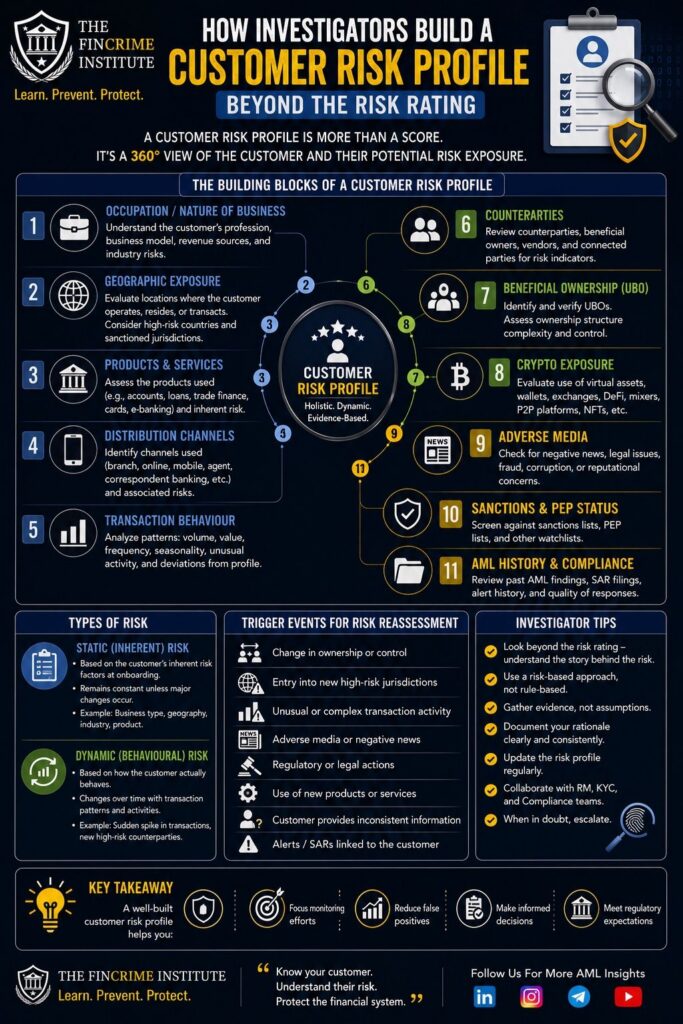
A number of areas of customer profile depictions and activities are covered here by the FinCrime Institute. There are some that may not be as obvious as an unusual transaction and/or a very high value one. Of course, these two can be combined in a transaction that deserves scrutiny.
A less revealing one that can be a telltale sign and something worth investigating with a few questions before automatically acceding to the customer request is “use of new financial product or services”.
One that comes to mind is a high-risk wire request from a consumer who never used this product in their time with the financial institution and the behavior has never been conducive to needing to use such an instrument in their ongoing banking transaction activity (i.e., deposits versus making any withdrawals) based on the purpose of the account.
At a fraud prevention webinar for consumers put on by the Nova Scotia chapter of the Canadian Association of Retired Persons (CARP) a few years ago, a veteran RCMP officer, who was part of the expert panel providing tips and advice to attendees, said unequivocally that if there is one thing he can say is a red flag to someone being defrauded is when they are instructed to use a wire to transfer money.
There are likely other good examples, but the point of doing a customer risk profile is a KYC exercise to know more about your client and what you need to do to protect them and your financial institution from unnecessarily sending money to proceeds of crime.
And this is not a one-time onboarding function as life events happen and can be a factor that you need to be cognizant of in assessing a customer’s current profile. There are trigger events and you need to be aware of how they can elevate risk.

The FinCrime Institute
Educating the Future of Financial Crime Prevention
**🔍 Beyond the Risk Rating: How Investigators Build a Customer Risk Profile**
A customer’s risk profile is **far more than a Low, Medium, or High label.**
For AML investigators, it’s a **360° assessment** that evolves over time based on customer behaviour, business activities, geographic exposure, transaction patterns, and emerging risk indicators.
Effective AML investigations don’t start with assumptions—they start with understanding the customer.
### 🧩 Key Components of a Strong Customer Risk Profile
✔️ Occupation and nature of business
✔️ Geographic exposure and high-risk jurisdictions
✔️ Products and services used
✔️ Distribution channels (branch, online, mobile, agents)
✔️ Transaction behaviour and expected activity
✔️ Counterparties and business relationships
✔️ Beneficial Ownership (UBO)
✔️ Crypto and virtual asset exposure
✔️ Adverse media and reputational risks
✔️ Sanctions and PEP screening
✔️ Historical AML findings and previous alerts
Each of these factors contributes to a more accurate understanding of customer risk and supports better investigative decisions.
### ⚖️ Static Risk vs. Dynamic Risk
**Static Risk** includes factors that rarely change, such as:
* Industry
* Legal entity type
* Country of incorporation
* Products at onboarding
**Dynamic Risk** evolves over time and reflects how the customer actually behaves, including:
* Changes in transaction patterns
* New counterparties
* Expansion into high-risk jurisdictions
* Adverse media
* New products or services
* Regulatory or legal developments
A customer who was once considered low risk can become high risk if their behaviour changes significantly.
### 🚨 When Should Risk Be Reassessed?
A customer risk profile should never remain static. Common trigger events include:
• Significant changes in transaction activity
• Changes in ownership or control
• New adverse media or legal proceedings
• Exposure to sanctioned or high-risk jurisdictions
• Use of new financial products or services
• Filing of multiple AML alerts or SARs
### 💡 Key Takeaway
A strong AML investigation isn’t driven by a risk score—it’s driven by **context, evidence, and continuous assessment**.
The best investigators look beyond the rating to understand the story behind the customer. That’s how meaningful risks are identified, false positives are reduced, and regulatory expectations are met.
**💬 In your organization, what factor has the biggest impact on a customer’s risk profile—transaction behaviour, geography, beneficial ownership, or something else? Share your perspective below.**
hashtag#TheFinCrimeInstitute hashtag#AMLEdge hashtag#AML hashtag#CustomerRiskAssessment hashtag#RiskBasedApproach hashtag#KYC hashtag#CDD hashtag#EDD hashtag#UBO hashtag#PEP hashtag#Sanctions hashtag#TransactionMonitoring hashtag#FinancialCrime hashtag#Compliance hashtag#RiskManagement hashtag#AMLInvestigation hashtag#FinancialIntelligence hashtag#Banking hashtag#Fintech hashtag#KnowYourCustomer