As evident from this FinCrime post, the responder Louisa Bowman gives credence to remaining objective and not jumping to any conclusion at the outset of an investigation. Look at all the evidence and take it from there. This goes for ones which appear legitimate or suspicious.
Ms. Bowman says,” The objective is to assess the transaction within the broader context of the customer’s profile, expected activity, counterparties, historical behavior, and supporting evidence.”
Does this customer normally make the request being asked of their financial institution?
Or to frame it another way, is the transaction something they often do and have had no issues with?
Is what they are requesting a typical one that aligns with the customer’s profile and behavior from past activity?
If not, are they familiar with the risk they are taking in terms of the investment they are making and the financial instrument that is being used to process the movement of money?
Assumptions or hunches are not good enough as you need to understand the context and examine the evidence.

The FinCrime Institute
Educating the Future of Financial Crime Prevention
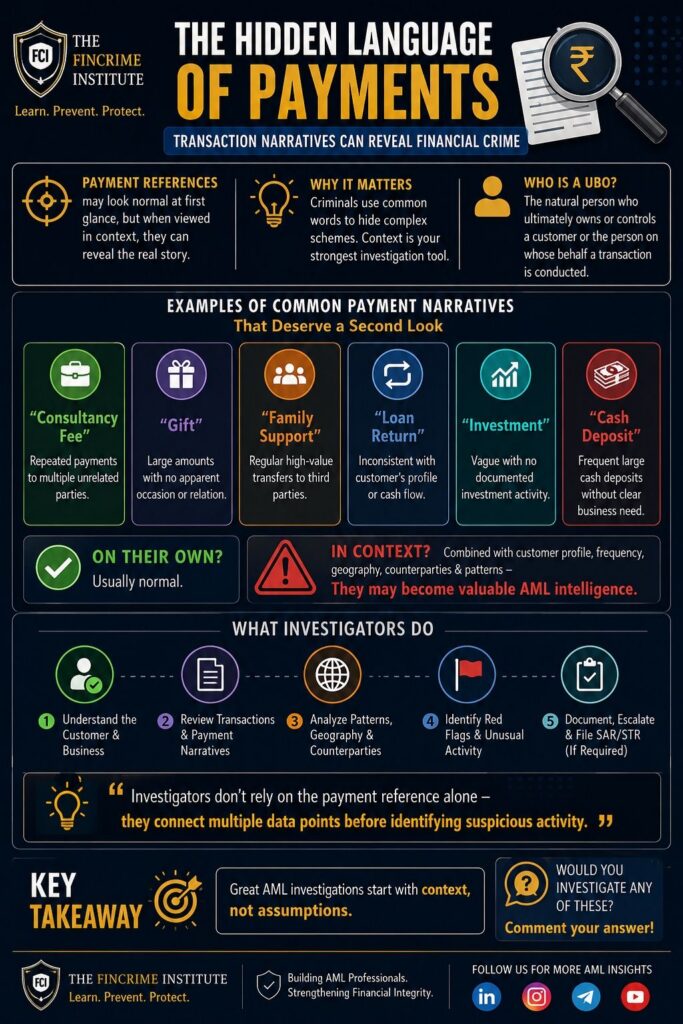
**🔎 A Payment Description Is Never the Investigation. It’s Only the Starting Point.**
One of the biggest misconceptions in AML is believing that suspicious activity can be identified simply by reading the payment description.
Terms like **”Gift,” “Consultancy Fee,” “Loan Return,” “Investment,”** or **”Family Support”** are not inherently suspicious. In fact, millions of legitimate transactions use these narratives every day.
So what makes them suspicious?
It’s the **context** behind the transaction.
An AML investigator evaluates:
• Does the transaction align with the customer’s known profile?
• Is there a legitimate business or economic purpose?
• Are the amounts, frequency, and counterparties consistent with expected behaviour?
• Are multiple red flags appearing together rather than in isolation?
A transaction narrative is just one piece of the puzzle. The real investigation begins when you connect customer information, transaction patterns, geography, ownership, and behavioural indicators to determine whether the activity truly warrants escalation.
**The best AML investigators don’t jump to conclusions—they build evidence-based narratives.**
💬 **Question for the community:**
Have you ever come across a transaction that looked perfectly normal at first but turned out to be suspicious after further investigation?
hashtag#AML hashtag#TransactionMonitoring hashtag#FinancialCrime hashtag#Compliance hashtag#KYC hashtag#SAR hashtag#FinCrime hashtag#RiskManagement hashtag#AMLInvestigation hashtag#FinancialIntelligence hashtag#TheFinCrimeInstitute

Louisa Bowman, CAMS
AML/KYC Compliance Consultant | Customer & Merchant Onboarding | Risk Management & Financial Crime Prevention | Career Coach | Founder, AML KYC Insights
Excellent perspective.
One principle that every AML investigator should keep in mind is to avoid confirmation bias. A payment description may initially appear suspicious—or perfectly legitimate—but neither impression should drive the investigation. The objective is to assess the transaction within the broader context of the customer’s profile, expected activity, counterparties, historical behavior, and supporting evidence.
The strongest investigations remain objective from start to finish. They challenge initial assumptions, consider alternative explanations, and reach conclusions based on corroborated facts rather than isolated indicators.
Ultimately, payment narratives provide context—but it’s the complete body of evidence that determines whether an activity is legitimate or warrants further escalation.