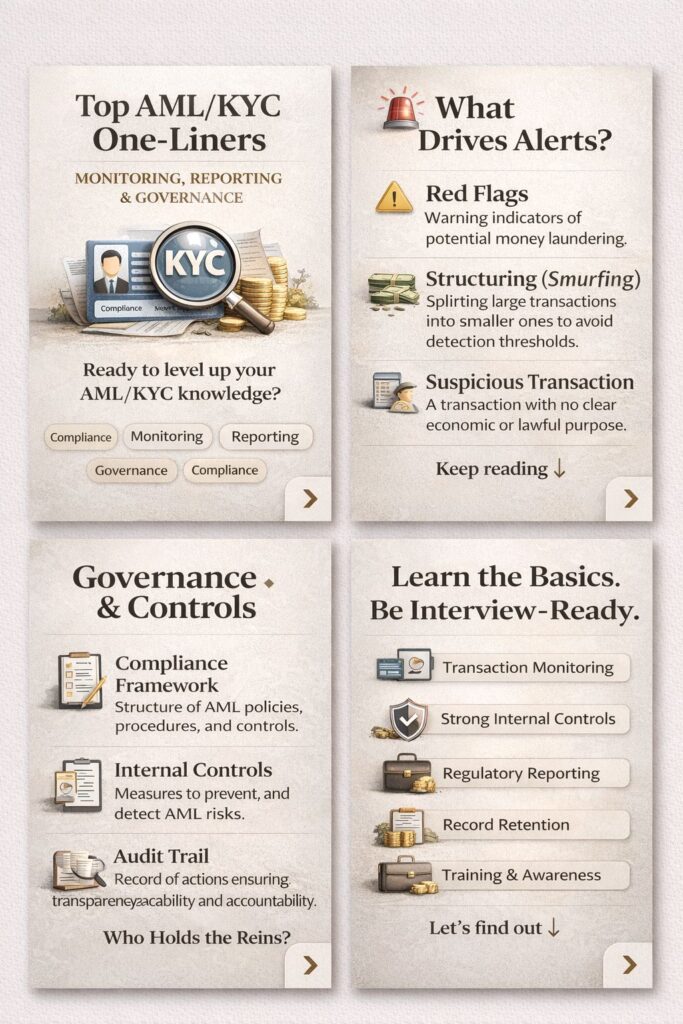
This LinkedIn post below by Muskan Rai is to the point and effective in conveying important fraud terminology. Moreover, it stresses how you need to connect the terms with the process and understand AML is about the flow: Detect>Review>Investigate>Report>Control
Without coming out and saying it directly. but it is certainly implied here, financial institutions need to be hiring strong candidates to be able to grasp these terms in a way that can be applied effectively and consistenlty to prevent scams at the outset.

Muskan Rai
Risk Analyst @ Genpact | Financial Crime Risk Management
🔥 Top AML/KYC One-Liners (Monitoring, Reporting & Governance)
Simple. Practical. Interview-ready.
These are the lines you should be able to recall instantly 👇
🚨 Monitoring & Reporting
1. Transaction Monitoring (TM) → Identifies unusual or suspicious transaction patterns.
2. Red Flags → Warning indicators of potential money laundering activity.
3. Structuring (Smurfing) → Splitting large transactions into smaller ones to avoid detection thresholds.
4. Suspicious Transaction → A transaction with no clear economic or lawful purpose.
5. STR / SAR → Reports filed to authorities for suspicious activities.
6. Tipping Off → Illegally informing a customer about a SAR or investigation.
7. False Positives → Alerts flagged as suspicious but actually legitimate.
8. Alert Review → Analyzing alerts to determine if suspicion is valid.
9. Case Management → Tracking investigations, actions, and final decisions.
10. Escalation → Reporting high-risk concerns to senior compliance levels.
🏦 Governance & Controls
11. Compliance Framework → Structure of AML policies, procedures, and controls.
12. Internal Controls → Measures to prevent and detect AML risks.
13. Audit Trail → Record of actions ensuring transparency and accountability.
14. Regulatory Reporting → Mandatory reporting to regulators and authorities.
15. Record Retention → Storing KYC and transaction data as per regulations.
16. Training & Awareness → Educating employees on AML obligations and risks.
17. Independent Audit → External/internal review of AML program effectiveness.
18. Model Validation → Testing TM systems for accuracy and reliability.
19. Risk Assessment → Identifying and evaluating AML risks.
20. Culture of Compliance → Promoting ethical behavior across the organization.
🧠 Quick Insight
AML isn’t just definitions.
👉 It’s a flow: Detect → Review → Investigate → Report → Control
📌 Interview Edge
When answering, connect terms with real processes.
That’s what separates average from strong candidates.
hashtag#AML hashtag#KYC hashtag#TransactionMonitoring hashtag#Compliance hashtag#RiskManagement hashtag#FinancialCrime hashtag#EDD hashtag#Audit hashtag#Banking hashtag#FinCrime